Welcome!

Dear Book Lovers, Welcome! I am delighted that you have found The Through the Looking Glass blog. For over twenty years I reviewed children's literature titles for my online journal, which came out six times a year. Every book review written for that publication can be found on the Through the Looking Glass website (the link is below). I am now moving in a different direction, though the columns that I write are still book-centric. Instead of writing reviews, I'm offering you columns on topics that have been inspired by wonderful books that I have read. I tell you about the books in question, and describe how they have have impacted me. This may sound peculiar to some of you, but the books that I tend to choose are ones that resonate with me on some level. Therefore, when I read the last page and close the covers, I am not quite the same person that I was when first I started reading the book. The shift in my perspective might be miniscule, but it is still there. The books I am looking are both about adult and children's titles. Some of the children's titles will appeal to adults, while others will not. Some of the adult titles will appeal to younger readers, particularly those who are eager to expand their horizons.

Tuesday, February 2, 2010

Happy Groundhog Day!

Every February 2nd Punxsutawney Phil emerges from his burrow in Pennsylvania to see if he can see his shadow or not. If he does see his shadow, then we are all in for six more weeks of winter. If he doesn't see his shadow then spring will arrive early this year. 

This morning Punxsutawney Phil saw his shadow, and we therefore have six more weeks of winter to look forward to. Some of you might be wondering what a groundhog is. Here is a little information: 


The groundhog (Marmota monax), also known as a woodchuck or whistle-pig, or in some areas as a land-beaver, is a rodent of the family Sciuridae, belonging to the group of large ground squirrels known as marmots. Other marmots, such as the yellow-bellied and hoary marmots, live in rocky and mountainous areas, but the woodchuck is a lowland creature. It is widely distributed in North America and common in the northeastern and central United States. Groundhogs are found as far north as Alaska, with their habitat extending southeast to Alabama.


And what about Groundhog Day. What is this all about. How did it all begin?

Groundhog Day is an annual holiday celebrated on February 2. It is held in the United States and Canada. According to folklore, if a groundhog emerging from its burrow on this day fails to see its shadow, it will leave the burrow, signifying that winter will soon end. If on the other hand, the groundhog sees its shadow, the groundhog will supposedly retreat into its burrow, and winter will continue for six more weeks. The holiday, which began as a Pennsylvania German custom in southeastern and central Pennsylvania in the 18th and 19th centuries, has its origins in ancient European weather lore, wherein a badger or sacred bear is the prognosticator as opposed to a groundhog. The holiday also bears some similarities to the medieval Catholic holiday of Candlemas. It also bears similarities to the Pagan festival of Imbolc, the seasonal turning point of the Celtic calendar, which is celebrated on February 2 and also involves weather prognostication.
Modern customs of the holiday involve celebrations where early morning festivals are held to watch the groundhog emerging from its burrow. In southeastern Pennsylvania, Groundhog Lodges (Grundsow Lodges) celebrate the holiday withfersommlinge, social events in which food is served, speeches are made, and one or more g'spiel (plays or skits) are performed for entertainment. The Pennsylvania German dialect is the only language spoken at the event, and those who speak English pay a penalty, usually in the form of a nickel, dime or quarter, per word spoken, put into a bowl in the center of the table.
The largest Groundhog Day celebration is held in PunxsutawneyPennsylvania, where crowds as high as 40,000 have gathered to celebrate the holiday since at least 1886. Other celebrations of note in Pennsylvania take place in Quarryvillein Lancaster County, the Anthracite Region of Schuylkill County, the Sinnamahoning Valley and Bucks County. Outside of Pennsylvania, notable celebrations occur in the Frederick and Hagerstown areas of Maryland, the Shenandoah Valley of Virginia, Woodstock, Illinois, and among the Amish populations of over twenty states and Canada. The University of Dallas in Irving,Texas has taken Groundhog Day as its official university holiday and organizes a large-scale celebration every year in honor of the Groundhog.
Groundhog Day received worldwide attention as a result of the 1993 film of the same name, Groundhog Day, which was set in Punxsutawney (though filmed primarily in WoodstockIllinois) and featured Punxsutawney Phil. 

I have reviewed several wonderful picture books for children about Groundhog day. You can read these reviews here


Thursday, January 28, 2010

The 2009 Newbery and Caldecott award winners

This week I was lucky enough to be able to read and review two new award winning books. One is the 2009 Caldecott winner, The lion and the mouse by Jerry Pinkney. The other is the 2009 Newbery winner, When you reach me by Rebecca Stead. Pinkey's artwork delighted me so much that I looked through the book four times before I wrote my review. As for When you reach me, well it just blew me away. I usually find books that talk about time travel confusing. This one was so magical that I starting telling everyone I know that they should read it as soon as possible.


When you reach me

Rebecca Stead
Fiction
Ages 12 and up
Scholastic, 2009, 0385737424
Miranda’s problems seem to begin after one of the neighborhood boys punches her best friend Sal in the stomach. Sal retreats from Miranda’s company, and suddenly she finds that she is all alone. She has to walk past the “crazy guy” on the corner by herself, and she has no one to spend her time with. Quite by chance, soon after she loses Sal, Annemarie’s friendship with Julia goes south, so Miranda and Annemarie start spending time together. Then Colin joins their little duo, and the three children begin to spend their school lunch break working at a local sandwich shop.
   After her first day of “work” Miranda comes home to discover that her apartment door is not locked. Nothing has been stolen, but Miranda finds out that something was left behind – a note. The writer of the note tells Miranda that he or she is “coming to save your friend’s life, and my own.” He or she also asks Miranda to write a letter and to “mention the location of your house key.” The writer talks about a trip and how he or she “will not be myself when I reach you.” What on earth is going on?
    This is only the first of several letters that Miranda finds. They all appear under the most mysterious of circumstances, and what they say makes no sense at all. What does become apparent is that the writer seems to know what is going to happen before it happens. How is this even possible?
   In this extraordinary book, Rebecca Stead takes her readers on an incredible journey into the fantastic. She explores time travel and friendships, and she gives her readers a mystery that is tantalizing, intriguing, thought-provoking, and even magical. Without a superfluity of words, Rebecca Stead’s novel is a powerful tour de force that will leave readers spellbound and perhaps slightly dazed.
   The title won the 2009 Newbery Award.   


The lion and the mouse
Jerry Pinkney
Picture Book
For all ages
Little Brown, 2009, 9780316-01356-7

One morning a mouse, who is very distracted, accidentally runs up the back of a sleeping lion. Needless to say, the lion is not pleased. He could easily eat the little mouse that sits quivering in his paw. Instead, the lion, in an act of compassion, lets the little mouse go.
   Then one day, some hunters set out a trap, which the lion walks right into. Though he is the king of the savannah, the lion cannot free himself from the hunter’s rope net. He is well and truly caught. The little mouse hears the lion’s roar, and she quickly runs to where the lion hangs from a tree, trussed up in the rope net. Though she is just a very little mouse, there is something that she can do to help the great lion, and she gets to work.
   This beautiful retelling of one of Aesop’s most beloved tales will delight readers of all ages. The only words in the book are sound words; squeaks and roars, the hoots of an owl, and the “Putt-Putt-Putt,” of a car engine. Jerry Pinkney perfectly captures the essence of the fable with his gorgeous paintings, which are rich with the golden colors of an African grassland. Readers will have no trouble seeing that this story not only looks at the gift of compassion, but it also highlights the fact that even the smallest and weakest individuals have something valuable to give. The “meek” can truly have something to offer the “mighty.”

Tuesday, January 26, 2010

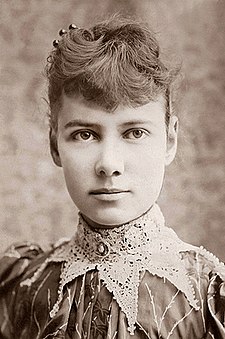
On this day: Nellie Bly ends her trip around the world

On this day in 1890 a young reporter ended an amazing journey around the world. Her name was Nellie Bly (her real name was Elizabeth Jane Cochran) and she was determined to prove that she could travel around the world in less than eighty days. People all over the world watched to see if this pretty young woman could break the record of Phileas Fogg, Jules Verne's ficticious character who traveled around the world in eighty days by boat and train in Verne's famous book Around the World in Eighty Days.
Nellie's journey began on November 14th, 1889, and it ended "seventy-two days, six hours, eleven minutes and fourteen seconds after her Hoboken departure."


I have read several books about Nellie and her incredible journey, and you can read my reviews here on Through the Looking Glass Book Review. 


You can find more information about Nellie Bly and her remarkable career here on Wikipedia. 

Monday, January 25, 2010

Snowflake Bentley Books


As promised I am posting two reviews about Wilson Bentley, the man who first photographed snowflakes. These titles are, of course, for children, but adults will also greatly enjoy them.


Snowflake Bentley
Jacqueline Briggs Martin
Illustrated by Mary Azarian
Non-Fiction Picture Book
Ages 6 to 8
Houghton Mifflin, 1998, 0-395-86162-4
   Little Willie Bentley loved the snow. He loved to play in it and he loved to look at it, comparing the snow to “apple blossoms.” Unlike apple blossoms however, snowflakes could not be looked at for long because they quickly melted. It was hard to enjoy and study the snow when it disappeared so fast. Then, using a microscope that his mother gave him, Willie began to look at snowflakes up close and he would quickly draw the ice crystals that he saw through the eyepiece. Even working as quickly as he could Willie was never able to finish his drawings before the beautiful crystal formations melted.
   Then, at last, Willie’s parents bought him a microscope that had a camera attached to it. Now Willie could photograph the snowflakes before they had a chance to melt, and he would have their images on glass plates to study at his leisure. After many months of failure Willie finally figured out how to take the photographs. He learned how snowflakes form, and that each and every snowflake is unique.
   In time people began to recognize how beautiful and useful Willie’s photographs were, and he sold many copies of his pictures to people all over the country. When he was sixty-six Willie’s book “Snow Crystals” was published, and it is still read and enjoyed by scientists, artists and others who live all over the world.
   With Mary Azarian’s superb woodcuts to illustrate it, this fascinating book captures the essence of a man who did what he loved even though he was made fun of, and even though he did not make any money from his passion. Bentley took his photographs because the beauty of snow fascinated him and because he wanted to share the beauty that he saw with others. We are able to see that though he was a scientist who studied the weather and snow formation, he was also an artist at heart who was happiest when he was capturing the images of snowflakes on plates of glass.
   This book was the 1999 Caldecott Medal winner.

You can purchase this book through this blog here.


My brother Loved snowflakes: The Story of Wilson A. Bentley, the Snowflake Man
Mary Bahr
Illustrated by Laura Jacobsen
Non-Fiction and fiction Picture book
Ages 5 to 7
Boyds Mills Press, 2002, 1-56397-689-7
  Charlie and Willie Bentley live with their parents on a farm in Vermont. The boys are educated at home and their mother, who is delighted by Willie’s abilities, gets her son a microscope. Willie loves the microscope, spending a good part of his spare time looking at all kinds of things under the lens. More than anything Willie looks at drops of water, marveling at what he sees. When it begins to snow in the winter time, Willie looks at a snowflake under the lens and what he sees changes Willie’s life.
  Willie is entranced by the beautiful snowflakes, and he was to capture their likeness on paper. Unfortunately, his subjects refuse to accommodate him; they keep melting. Eventually Willie finds a solution to the problem. He buys a microscope that works with a camera, and after many hours of trying, Willie finds a way to get the images that he is looking for.
  Many people wonder why Willie persists in taking pictures of snowflakes, writing a book about them, and showing his photographs to people, but Charlie just delights in his brother’s creativity, his determination, his appreciation of the natural world, and his kindness.
  Told from the point of view of Willie’s brother, this is an excellent account of Wilson A. Bentley’s extraordinary life. Richly colored artwork in vivid reds, oranges and other warm colors perfectly compliment the text.
  At the back of the book the author provides her readers with further information about Snowflake Bentley.


You can purchase this book through this blog here.

You might also like to read a copy of Bentley's own book. Copies of this title are available here.


Thursday, January 21, 2010

A wonderful book about snow


In the last week or so Oregon, where I live, has been hammered by storm after storm. Loud winds have woken me up in the middle of the night, and the mountains around my town are all dusted with snow. Looking at the frost dusted trees as I drink my first cup of coffee in the morning gives me a great deal of pleasure.

Yesterday I read and reviewed a wonderful nonfiction picture book about snow. I was in my local bookshop sipping a latte and reading the book, when a lady came up to me and asked if she could look at the pictures because "they look so beautiful," which they are.

Here is my review:


The story of Snow: The science of Winter’s wonder
Mark Cassino with John Nelson, Ph.D.
Nonfiction picture book
Ages 5 to 7
Chronicle Books, 2009, 0811868664
   This story begins in the clouds, which are mostly made up of air and water (invisible things), and “specks,” which we can see. These specks can be particles of soil, ash, or soot, pollen grains, or even living bacteria. Under the right conditions, water vapor sticks to a “speck” and sticks, forming an icy shell. As more and more layers of vapor stick to the speck, it grows in size until it forms a small ball of ice. This ball of ice eventually turns into a “hexagon-shaped ice crystal,” which grows until is becomes a beautiful, unique snow crystal.
   The snow Crystal can be star-shaped, plate-shaped, or column-shaped, and like humans, leaves, and flowers, no two are alike. When several crystals stick together, they form a snowflake.
   Full of gorgeous pictures of real snowflakes, this wonderful nonfiction picture book will delight children who love the snow. It will also appeal to readers who have an interest in the weather and science. At the back of the book there is a section that will teach readers “How to catch you own snow crystals.”

You can find more books about Snowy Days on the TTLG website.


If you don't feel like going out to borrow or buy this book, you can buy it here on Amazon. Enjoy.
Bookmark and Share