Welcome!

Dear Book Lovers, Welcome! I am delighted that you have found The Through the Looking Glass blog. For over twenty years I reviewed children's literature titles for my online journal, which came out six times a year. Every book review written for that publication can be found on the Through the Looking Glass website (the link is below). I am now moving in a different direction, though the columns that I write are still book-centric. Instead of writing reviews, I'm offering you columns on topics that have been inspired by wonderful books that I have read. I tell you about the books in question, and describe how they have have impacted me. This may sound peculiar to some of you, but the books that I tend to choose are ones that resonate with me on some level. Therefore, when I read the last page and close the covers, I am not quite the same person that I was when first I started reading the book. The shift in my perspective might be miniscule, but it is still there. The books I am looking are both about adult and children's titles. Some of the children's titles will appeal to adults, while others will not. Some of the adult titles will appeal to younger readers, particularly those who are eager to expand their horizons.

Monday, April 1, 2013

Picture Book Monday - A review of Red Kite, Blue Kite

Telling the story of a terrible time or experience is not easy, especially when you want to tell the story to young children. In today's picture book the author gives children a sense of what it was like to be a little child during China's Cultural Revolution. Often moments in the account are sad, but hope is always there and that hope makes this a powerful, memorable, and beautiful book.


Ji-li Jiang
Illustrated by Greg Ruth
Picture Book
For ages 7 to 9
Hyperion, 2013, 978-142312753-6
One of Tai Shan’s favorite things to do is to go to the “tippy-top” of the roof of his house with his Baba to fly kites. Tai Shan’s kite is a small red one, and his father’s is a big blue one. As they fly their kites together Baba tells his son stories, stories that make their time together on the roof particularly special. Up there flying his kite Tai Shan feels as free as the kite that is flying above his head.
   Then “a bad time” comes and Tai Shan’s life is turned upside down. Schools are closed and Baba is sent to work at a labor camp. Since Tai Shan’s mother died when Tai Shan was born, the little boy is sent to stay in a village with a farmer called Granny Wang. Though Granny Wang is kind to Tai Shan, the little boy misses his father whom he sees only one day a week, on Sunday. Every Sunday Baba walks for miles from his camp to the village where Tai Shan is living, and on this one day the father and son fly their kites as they used to do.
   Then one day Tai Shan’s father tells his son that he will not be able to visit for a while. To stay connected to his son Tai Shan’s father comes up with a plan. Tai Shan should fly his red kite every morning, and his father will fly his blue kite every sunset. Their kites will be their own private “secret signal.”
   Day after day the two kites send their messages of love to Tai Shan and his Baba even though they are miles apart. Then one day Baba’s blue kite does not appear.
   Based on a true story about a boy and his father during China’s Cultural Revolution, this evocative picture book beautifully captures the power that hope can have on people during hard times. At such times, small things, like red and blue kites, come to represent something precious.
   With a memorable story and lovely illustrations, this picture book gives readers an experience that they will remember long after the last page is read. 

Sunday, March 31, 2013

Happy Easter!

A Very Happy Easter To You All

Friday, March 29, 2013

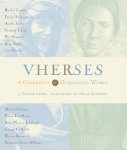
Poetry Friday - A review of Vherses: A celebration of outstanding women


Women's History Month, which is celebrated in the United States every March,  is wrapping up in just a few days, so I thought that I would offer you a poetry book today that commemorates the lives and achievements of fourteen extraordinary women. Any reader over the age of eight will gain something from reading this title.

J. Patrick Lewis
Illustrated by Mark Summers
Poetry Picture Bok                               
For ages 8 and up
Creative Editions, 2005, 1-56846-185-2
For hundreds of years women lived restricted lives. A male dominated society dictated what women could or could not do, and the could nots greatly outweighed the coulds. Of course, some women chose to challenge the system, and in the eighteen hundreds more and more women dared to do things that were considered unsuitable for the gentler sex.
   In this splendid collection of poems J. Patrick Lewis celebrates the lives of fourteen women who chose to do something meaningful and sometimes controversial with their lives. The first poem is about Emily Dickinson, a woman who wrote poetry that was unusual and unconventional, who had the courage to be true to herself. Emily had her own voice and style, choosing “to weave a word,” and living a quiet life that was full of solitude and reflection.
   Georgia O’Keefe and Martha Graham also chose to find their own ways to express the creativity that lay in their souls. Georgia created paintings whose unique colors and themes startled people. Martha Graham dared to dance in a different way, focusing on “excitement and surge,” rather than beauty and elegance.
   Then there are the women who had a different sort of courage. Eleanor Roosevelt “the great first lady” who “Looked fear in the face,” championed the poor, the disenfranchised, and the downtrodden. Fannie Lou Hamer also chose to speak out. In her case she fought for the rights of America’s African American citizens, defending their right to vote and their right to freedom.
   In a similar way, Rachel Carson chose to speak for Nature, whose voice was being ignored. Her “little book,” which was called Silent Spring, helped people to understand that humans cannot take nature for granted, and that they need to care for and conserve our beautiful and wild places and our natural resources.
  J. Patrick Lewis also celebrates the lives of women who pushed their courage and bodies to new heights. Amelia Earhart dared to be the first women to fly solo across the Atlantic and pushed on even when her altimeter failed and when her plane’s wings “were icing over.” Gertrude Ederle also had to overcome appalling conditions when she swam the English Channel and made the fastest crossing made “By woman or by man.”
   Throughout this book, beautiful poetry and lovely art is paired with short descriptions of the lives of the fourteen women mentioned. The collection will touch, inspire, and appeal to readers of all ages.

Monday, March 25, 2013

Picture Book Monday - A review of Oh! If Only...

I don't want to tell you have many times I have said "If only..." to myself or to others. Regret is hard to dodge or avoid. It sneaks up on you when you least expect it. Most of the time it is a useless feeling to have. In today's picture book Micheal Foreman tells the story of one boy's "If only..." moment, and in this case at least it is a funny moment, a moment that will put a smile on every reader's face.

Michael Foreman
Picture Book
For ages 5 to 7
Andersen Press USA, 2013, 978-1-4677-1213-2
Sometimes bad things happen, and when we look back on the events that led to the bad thing happening we wish “If only…” If only we’d remembered to water the plant so that it hadn’t wilted and died. If only we had taken our medicine when the doctor told us to so that we hadn’t got sick again. Life is full of if onlys, but for most people not many them end up being that dramatic.
   In this story you are going to meet a boy whose If Only experience ends up getting him in terrible trouble. One day he goes out and meets a dog who is carrying a little red ball. The dog clearly wants the boy to play with him, and so the boy starts kicking the ball up in the air. Unfortunately, the boy is not very good at soccer and so the ball bounces down the hill, it frightens an old lady’s cats, which frighten some birds, which spook some horses that are walking in a parade. The spooked horses cause such as kerfuffle that the big parade is “wrecked.” What a mess! The problem is that this is not the end of the story. More chaos ensues and the boy’s situation gets worse and worse. And worse.
   Children are going to enjoy this very unusual picture book. They are going to laugh at the scenes that unfold, and they will wonder what is going to happen next. They will surely be surprised when they come to the last page and find out that the ending is, well, rather surprising.

Friday, March 22, 2013

Poetry Friday - A review of Poetry for Young People:Robert Frost

On March 26, 1874, Robert Frost was born in San Francisco, California. Since the 26th is only a few days away, I thought I would share a wonderful collection of his poems with you today.

Edited by Gary D. Schmidt
Illustrated by Henri Sorensen
Poetry
For ages 9 and up
Sterling, 2008, 978-1-4027-5475-3
Robert Frost and his poems are often associated with New England, snow, stone walls, and white birches. What many people don’t know is that he did not start life living in this part of the United States. Robert was born in San Francisco and lived in California until his father died in 1885. Not having any money, Robert’s mother moved her family to Massachusetts, where she lived with her father-in-law for a while. Then she managed to get a teaching job in Salem, New Hampshire. A teacher’s pay was not enough to provide for three people, so Robert worked at a cobbler’s shop where he nailed heels onto boots.
Robert did well in school, and was delighted when his grandfather made it possible for him to attend Laurence High School. Robert did very well there and was able to get into Dartmouth College, which was something his grandfather wanted. However, Robert was not interested in attending college and he dropped out. What Robert did want to do was to write poetry, and this is what he did when he wasn’t working. Though he dreamed of being a recognized poet, he never imagined, back in those early days, that one day he would win awards and would read one of his poems at a presidential inauguration ceremony. What was it about Robert’s poems that made them so popular during his lifetime and beyond?
In this superb collection some of Robert Frost’s most beloved poems are brought together so that young (and not so young) readers can see for themselves why his poems are liked by so many people around the world. The poems are divided up into four sections, one section for each of the seasons, and we begin with summer. Many of the poems celebrate country life and nature. In The Pasture, the narrator invites us to “come too” when he goes to clean the pasture spring, and when he fetches a little calf. In another poem he takes us out into a hayfield where he is turning the drying grass that has been cut for hay. The job is a tedious one until the worker’s eye catches the movement of a butterfly. The little insect shows the worker something special and they are united in that moment.
On the section of Autumn poems, we hear from a little bluebird who leaves a message for a girl called Lesley. The bluebird has felt the cold touch of the north wind and he must fly south. Perhaps, “in the spring” he will come “back and sing.” We read about falling leaves that “fit the earth like a leather glove,” and join someone who has been picking apples and is ready for the rest that winter offers.
Every poem in this collection is accompanied by lovely and evocative paintings, and each one has a note from the editor that provides readers with background information about Robert Forest, his poems, and his style of writing. The combination of the poems, the art, and the notes gives readers an excellent portrait of Robert Frost and his work.
At the beginning of the book there is a short introduction written by the editor where readers will find an excellent description of Robert Frost’s life and legacy.


Wednesday, March 20, 2013

Happy Spring!


Happy Spring Everyone. 

There are some wonderful springish books on the TTLG Spring Books Page.
 I hope you find a book here that you will enjoy looking at and sharing.

Tuesday, March 19, 2013

A perfect book for women's history month

March is Women's History Month and I have just reviewed a wonderful title about an exceptional woman who did something special with her life.

Robert Burleigh
Illustrated by Raul Colon
Nonfiction Picture Book
For ages 6 to 8
Simon and Schuster, 2013, 978-1-4169-5819-2
When Henrietta was a young girl, she spent many hours staring up into the night sky, looking at the stars and getting familiar with their patterns. She was fascinated by “the wonderful bigness of all she saw,” and longed to find out more about space.
   When she was a young woman, she attended astronomy class and was one of the few women who did so. After graduation, Henrietta was able to get a job working in an observatory. Though the observatory had a wonderful big telescope, Henrietta rarely got to use it. Instead, she worked with a group of women measuring and calculating, doing the job that calculators and computers do today. Henrietta and the other women were told to “work, not think,” but Henrietta wasn’t going to accept such an existence. She had an enquiring mind and intended to use it, which she did, studying astronomy in her space time.
   Day after day Henrietta looked at photographs of stars, measuring and counting, and then she began to notice that there was a pattern. Some of the stars seemed to get dimmer and then brighter. Some blinked slower than others. Henrietta studied the pattern and she mapped it out. The chart that she created helped astronomers to figure out how far away the stars were. Thanks to her work, they also came to realize that our Milky Way was a lot bigger than they thought and that it was only one of many galaxies. Her discovery would have a profound effect on our understanding of our universe.
   This wonderfully written book tells the story of a woman who lived at a time when women had very few opportunities to work as scientists. Indeed, most of the time they were prevented from doing research. Henrietta never gave up, and in the end her determination and hard work paid off.
   Throughout the book Robert Burleigh’s lyrical prose is paired with Paul Colon’s wonderful artwork to give readers a memorable picture book biography.  
   Further information about Henrietta, other women astrologers, and more can be found at the back of the book.

Monday, March 18, 2013

Picture Book Monday - A review of Brave Bitsy and the Bear

Helping others, even when it is inconvenient, is something we all should do on a regular basis. I seriously believe that doing things for others and not expecting anything in return makes us better people. It also makes the world a better place. Today's picture explores how a bear and a toy bunny both choose to help someone else, even though doing so causes them problems.

Angela McAllister
Illustrated by Tiphanie Beeke
Picture Book
For ages 5 to 7
Clarion, 2004, 978-0-618-63994-6
One autumn afternoon Bitsy the toy bunny fell out of her little girl’s pocket and though Bitsy cried for help, her little girl did not hear her. Bitsy was all alone and lost in the woods and she felt frightened, but she boldly set off “singing a brave song.”
   Bitsy did not go far before she came face to face with a big bear. Though the bear had a frightening growl, he was a gentle fellow and though he was on his way to his cave to begin his winter sleep, he offered to take Bitsy home.
   The bear started to get sleepy and he warned Bitsy not let him fall asleep or he wouldn’t “wake up until spring.” Bitsy did her best to keep her companion awake and finally Bear, carrying Bitsy on his back, arrived at the house where the bunny lived with her little girl.
   That night Bitsy began to worry about her friend Bear. What if he did not make it back to his cave? If he fell asleep in the woods he would soon be covered with snow and he would freeze. In the morning Bitsy decided that she had to do something. She had to make sure that the kind bear was not in danger.
   Every so often someone comes along who is willing to go out of his or her way to do something kind for us. In this book readers will meet a bear who is just such a person, who is willing to do something that inconveniences him because he wants to help someone in need.
   With a heartwarming story and delightful illustrations, this is a picture book that will charm readers of all ages. 

Friday, March 15, 2013

Poetry Friday - A review of A Meal of Stars

I am constantly being surprised by the creativity of artists and writers. So many of them find interesting, beautiful, and novel ways to present their art and their words. In today's poetry title the words in the poems go up and down the page instead of across it. I can hear you asking: Why would anyone do this? Trust me, the author of this book has a very good reason for presenting her work in this way.

Dana Jensen
Illustrated by Tricia Tusa
Poetry Picture Book
For ages 6 to 9
Houghton Mifflin, 2012, 978-0-547-39007-9
Reading from left to right is the norm in most English language books, but sometimes poets like to do something different. In The Mouse’s Tale, Lewis Carroll presents his poem in such a way that the text looks like a mouse’s tail that wiggles its way down the page. Other poets have also found creative ways to present their poems to their readers by creating pictures with their words. In this book, poet Dana Jensen gives her readers poems that have something to do with looking or going up or down, and the poems are presented to readers so that they have to read up or down the page.
   In the first poem we read single words up the page to find out that a little child thinks that perhaps a giraffe has such a long neck that it might be able to “make / a / meal / of / stars.” Further along in the book there is another poem that begins at the bottom of the page. We meet a child who has a string in its hand that goes “up / to / a / big / bright / blue” balloon. And then, at the top of the page, up there in the sky at the end of the string, something happens. 
   Then there are the poems that go down the page, one word at a time. In one of the poems we are sitting at the top of a Ferris wheel “at / its / highest / point.” From that vantage point we look down at the “carnival / world” below that is scene full of “moving / sounds / and / colors.” In another poem we experience the sound of church bells “that / float / down” to children and touch them “with / their / songs.”
   Throughout this book, beautifully lyrical and minimal poems that go up or down the pages are paired with Tricia Tusa’s whimsical illustrations to give readers a poetry experience that is altogether fresh and exciting. 

Wednesday, March 13, 2013

Something Extra - A review of Destiny, Rewritten


Every so often a book comes along that is so splendid/marvelous/fabulous that I want to go to the top of the highest building and shout out how splendid/marvelous/fabulous it is. Since the tallest building around here is not tall at all and I would not reach many people shouting from the top, I am going to tell you about my latest Great Find. 

The book is called Destiny Revealed and it was written by Kathryn Fitzmaurice. The story explores how one eleven-old girl tries to understand what destiny is. She has been told that she will be a poet when she grows up, but what if she doesn't want to be a poet? What then? Can she write her own destiny?

Kathryn Fitzmaurice
Fiction
For ages 9 and up
HarperCollins, 2013, 978-0-06-162501-5
The day before her baby daughter is to born, Isabella goes to a second hand bookshop where she hopes she will be able find a name for her child. She is looking for a name that will set her daughter’s “life direction.” After discarding Juliet as too tragic a name, Isabella finds a copy of The Complete Poems of Emily Dickinson, and she knows in her heart that she has found what she is looking for. Her baby will be called Emily, and she will grow up to be a poet.
Emily is now eleven years old and she really does not care for poetry, though she does try to. She has the copy of The Complete Poems of Emily Dickinson that her mother bought and it is Emily’s most treasured possession because her mother has made notes in the book to commemorate important days in Emily’s life. The book tells Emily’s story. Or at least most of it. Emily still has no idea who her father is. Isabella firmly believes that when the time is right Emily will know who her father is. The problem is that Emily does not feel like waiting for that moment, and what if it doesn’t even exist? Emily wants to know who her father is now and she is stunned when her mother finally tells her that her father’s name is written in Emily’s precious copy of The Complete Poems of Emily Dickinson.
Emily runs to get her book only to find out that it got mixed up in a donation for Goodwill. The book is gone. Emily can hardly believe that her book, with all those wonderful notes from her mother, is gone forever. Emily’s mother believes that the book got lost because Emily wasn’t ready to find her father’s name. Isabella insists that things cannot be forced; they should be allowed to happen when they are supposed to happen, when they are destined to happen. Emily finds it hard to accept her mother’s take on destiny, and she wants to find that book no matter what it takes.
It ends up taking a lot. Emily and her mother go to the Goodwill store, but the book isn’t there. The person working at Goodwill tells them that the books are often picked over early by people buying books for bookstores. Now Emily is going to have search who knows how many book stores to find her book.
Desperate to find the book with her father’s name in it, Emily even goes so far as to set aside her rigidly organized and predictable way of doing things. She forces herself to be unpredictable, even when doing so pains her. She will do whatever it takes if there is a chance that she will find the book with its precious notes. She never expects that her journey will be full of surprises. As she tries to understand what is happening around her she will question who controls her destiny, and she will end up opening doors that she didn’t even know were there.
In this extraordinary book Kathryn Fitzmaurice explores the inner world of a young girl whose mother made a decision about her child’s future when that child was just an infant. It is quite remarkable to be able to see how Emily struggles to come to terms with the path her mother chose for her; a path that Emily does not feel is right for her. Emily’s voice, and the voices of the other characters in the book, are delightfully honest, genuine, and often sweetly funny, and readers will grow to love the quirky people who live in Emily’s world.
Though this book was written for younger readers, adults will get a lot out of reading it. They may even question the path they are on. It is a path that they are supposed to be following?


Monday, March 11, 2013

Picture Book Monday - A review of Cheer up, Mouse!

Cheering up someone who is down in the dumps can be very difficult sometimes. After all, we don't always know why the person is sad, and we often don't have any idea what will make them feel happy again. Would they like some flowers? Perhaps a dinner out will help. Maybe chocolate is the answer. In today's book you will see how some charming animals who try to cheer up their friend Mouse.


Jed Henry
Picture Book
For ages 4 to 6
Houghton Mifflin, 2012, 978-0-547-68107-8
Mouse and his animal friends are outdoors having a grand time. Frog and Mole are dancing around, Squirrel is playing his nut fiddle, and Badger is juggling some fruit. The only animal who is not enjoying himself is Mouse, who is looking awfully sad and dejected. When they see their little friend’s glum face, the animals try to come up with a plan. Surely there must be something that they can do to make Mouse smile.
   One of the birds tries to cheer up mouse by swinging him through the air, and then Frog tries to cheer up the little fellow by taking him to the pond for a “Splash and paddle, wash and wade.” Perhaps Mouse needs to “Leap and lope, hop and jump,” or “Dig and shovel, root and tunnel.” Maybe Mouse just need a meal!
   The animals try so hard to cheer up their friend, but nothing works. Nothing they do brings forth even a glimmer or a twitch of a smile.
   Most of us have days when we feel glum and when nothing we do seems to cheer us up. On days like these a little support from friends can make all the difference, as it does for the mouse in this story.
   With a minimal story and gorgeous and expressive art, Jed Henry explores a problem that will be familiar to many readers, and he gives us a perfect ending that will make readers feel happy through and through.   

Friday, March 8, 2013

Poetry Friday - A review of Please Bury me in the Library

I love books. Big surprise! I also love books that celebrate books. When I saw the cover of today's book, I just knew that I had to review it. I didn't even know what kind of book it was. The title grabbed me and it refused to let me go. It turns out that Please Bury Me in the Library is a fantastic collection of poems that celebrate books, reading, and the written word. Enjoy!
Please Bury Me in the Library
J. Patrick Lewis
Illustrated by Kyle M. Stone
Poetry Picture Book
For ages 7 and up
Harcourt, 2005, 0-15-216387-5
Some poor people think that books serve only one purpose. You read them to be entertained or educated. They do not know that a good book “is a homing device / For navigating paradise” and that such a book has “a spine, / A heart, a soul,” and its goal is “To light a fire / (You’re the fuse).” A good book will be there whenever you need it and it will even be a kind of friend.
   For this collection of poems J. Patrick Lewis finds a variety of ways to explore (and celebrate) books. There are so many different kinds of writing to enjoy. There are picture books, the best of which appeal to readers of all ages. Then there are poetry books, pop-up books, mysteries, myths, adventures, and legends. All of these kinds of writing give readers an experience that cannot be found by looking at a TV screen or a computer monitor.
   Some of the poems in the collection are about characters, such as Otto the Flea who wrote his “Ottobiography” and Elaine who loves words so much that even an exciting movie does not capture her interest. She would much rather read Webster’s Dictionary than follow the antics of Godzilla on the big screen.
  If you think this is rather over the top then you need to read about the person who wants to be buried in the library “With a dozen long-stemmed proses.” This person thinks that the “clean, well-lighted stacks” are the best place to spend eternity.
   Though this book is for young readers, the poems will appeal to readers of all ages. Some of the poems will make readers laugh, while others are thought-provoking and more cerebral. Though the poems are all very different in form and flavor, they do have one thing in common: the all celebrate the written word. 

Monday, March 4, 2013

Picture Book Monday - A review of Friends

True friends are a very rare and precious gift. They are people who will sacrifice a great deal for their friend's happiness, and who are always there in happy times and in times of trouble.
   In today's picture book you will meet a cat who is a superlative friend and who gives his best friend something more valuable than gold or diamonds.

Michael Foreman
Picture Book
For ages
Andersen Press USA, 2012, 978-1-4677-0317-8
Cat considers himself lucky because he is able to “wander wild and free, far and wide.” Cat’s friend Bubble is not so lucky. Bubble is a goldfish and he lives in a tank. Poor Bubble spends his days swimming around and around his aquarium. He never goes anywhere or sees anything, and Cat feels very sorry for him.
   One day, Cat is in the park when he sees a bucket in the sand box and he gets an idea. Cat fills the bucket with water and he carries it home. Then he encourages Bubble to jump into the bucket, which the little fish happily does.
   Cat takes Bubble to see the pond in the park, and to the river, and finally Bubble gets his first glimpse of the “wide, wide sea.” Bubble had no idea that there was so much to see out in the world. Then Cat invites Bubble to dive into the sea so that he too can be “wild and free.”
   True friends are a rare commodity. All too often a friend thinks of him or herself first, but this is not the case with Cat, who is willing to do whatever it takes to give his goldfish friend the opportunity to be free and at liberty.
   With wonderfully expressive watercolor illustrations and a powerful story with memorable characters, this is a picture book that readers of all ages will enjoy.

Friday, March 1, 2013

Poetry Friday - Poetry for young People: The Seasons

Over the centuries the seasons have inspired countless musicians, artists, and writers to create moving pieces of music, beautiful art, and wonderful stories and poems. Today's poetry title explores a few of the season-inspired poems that men and women have written over the years.

Poetry for Young People: The Seasons
Edited by John N. Serio
Illustrated by Robert Crockett
Poetry
For ages 9 and up
Sterling, 2005, 978-1-4027-1254-8
For hundreds of years poets have been inspired by the ambiences and scenes that we experience as the seasons shift from spring to summer, summer into fall, fall into winter, and thence back to spring again. Thinking of the seasons summons up memories in us that are touched by colors, sounds, tastes, and smells. When we think of fall we think of yellow and red leaves, we smell cold smoky air, and hear feet crunching through fallen leaves. Our mouths water as we remember the taste of a crunchy apple or the sweet spiciness of pumpkin pie.
   For this wonderful collection John N. Serio has selected poems that beautifully capture the flavor of each of the four seasons. For each season there are three haiku, a poetry form that is “traditionally built around the seasons.” The haiku are followed by a variety of poems that were written by contemporary poets and poets that lived long ago.
   We begin with summer, reading about an old dog that is “Much too lazy to rise and run” and who prefers to spends the hot summer days lying in the sun. Henry Wadsworth Longfellow gives us a picture of what it is like when there is a summer rain which gives us much needed relief from “the dust and heat.” His descriptions remind us that rain can indeed be a beautiful thing. Later in the book we meet Maggie, Milly, Molly, and May, four little girls who go to the beach to play. e. e. cummings describes how the girls find all kinds of little treasures on the beach, some which are wonderful and one which is not.
   In the section dedicated to autumn, we find a poem by Thomas Hood which is, in a manner of speaking, an ode to November. It is clear straight away that the poet has no great fondness for this month when there is “No sun – no moon!” and when there is “No shade, no shine, no butterflies, no bees” and nothing else that is cheerful and cheering. Emily Dickinson gives us are far more positive picture of autumn, telling us about a maple tree with its “gayer scarf” and the field with its “scarlet gown.”
   Like e. e. cummings, who does not care for November, T.S. Eliot does not seem to like winter much. He describes a grim, cold, grimy winter in a city where the rain beats down “On broken blinds and chimney-pots,” and where “grimy scraps” of “withered leaves” blow about. William Carlos Williams paints a much more attractive picture of trees, now bare of their leaves, that “stand sleeping in the cold” as “A liquid moon / moves gently among / the long branches.”
   The poems for spring are all positive, celebrating the beauty of flowers and tree blossoms, and capturing the lifting feelings of hope and joy that people get in their hearts when the sun starts to shine and the sky is blue. Emily Dickinson in particular shows us how happy she is to see March in her poem ‘Dear March, come in!” It is delightful to see how to talks to March as if the month was a person who needs to be invited in and to whom she has “so much to tell.”
   This is wonderful collection that readers of all ages will enjoy. The editor has written introductions for each of the poems, which tell us about the poet and his or her work. Sometimes the form of the poem is explained or discussed as well. 

Monday, February 25, 2013

Picture Book Monday - A review of Miss Annie: Freedom!

Young children and animals often believe that they are ready to do many, if not all, of the things that the "big kids" or grownups do. Children try to cook something and set food on fire They take clocks and other machines apart thinking that they will be able to put them back together. Kittens climb trees that they cannot figure out how to come down, and puppies pick fights with animals much bigger and tougher than they are.
   In today's graphic novel title you will meet a kitten who is determined to go out into the big world because she is convinced that she knows how to manage out there as well as she manages in her house.

Frank Le Gall
Illustrated by Flore Balthazar and Robin Doo
Graphic Novel
For ages 7 to 10
Lerner, 2012, 978-0-7613-7884-6
Miss Annie is a five month old kitten and she is convinced that she is old enough to do just about anything, and yet her people will not let her go outside. While her master walks in the park looking for inspiration, and her mistress works in an office, and her young mistress goes to school, Annie walks around the house looking for something to do. She plays with a pen, shreds a leaf from a flower arrangement, and finds a mouse. A live mouse.
   For some reason, though the mouse knows that mice are eaten by cats, and though Miss Annie knows that cats are supposed to eat mice, the mouse and Miss Annie become friends. When everyone is asleep that night Miss Annie gives the mouse a name and she tells the mouse all about her ambitions to go outside. Keisha the mouse cannot understand why Miss Annie would want to do such a thing. After all, “Outside is BIG and DANGEROUS.” Miss Annie is positive that she will be fine outside, but when she actually goes outside, she learns that she still has a lot to learn.
   All too often young creatures, including cats and humans, think they know everything there is to know. If they are lucky someone kind comes along who helps them realize that we never stop having to learn about the world we live in.
   With wonderful comic illustrations and a sensitive, sweet, and gently funny story, this graphic novel will appeal to readers of all ages.

Friday, February 22, 2013

Poetry Friday - A review of African American Poetry

February is Black History Month in the United States, and in honor of this celebration, I have reviewed a poetry title that brings together poetry written by some of America's greatest African American poets.

Edited by Arnold Rampersad and Marcellus Blount
Illustrated by Karen Barbour
Poetry Picture Book
For ages 9 and up
Sterling, 2012, 978-1-4027-1689-8
   The first book of poetry written by an African American was Poems on Various Subjects, Religious and Moral. The poet was Phillis Wheatley, who as a child was brought to America in a slave ship in 1761, and who became the property of a Boston gentleman. Phillis was lucky to end up in this household because her owners were kind and they encouraged Phillis to educate herself. Phillis made excellent progress with her studies and she began writing poetry in English when she was still very young.
   After Phillis’s death in 1784, very few African-Americans were given the opportunity to write poetry, and then a slave from North Carolin, George Moses Horton, began to write poetry and two of his collections were published in 1829 and 1845. Like Phillis, he used his poetry to “defend the humanity of African Americans,” and poets who came after him did the same.
   Then, during what came to be called the Harlem Renaissance, many young African Americans began to write poetry, and the words of Claude McKay, Langston Hughes, Countee Cullen and others delighted both African American and Caucasian readers. After the wounds caused by the Great Depression began to heal, more African American poets began to share their work with the world, using their words to ask for justice for their people, and to also tell their stories.
   In this extraordinary collection of poetry the editor presents the poems of African American poets in chronological order, which gives readers a real sense of how such poetry evolved and changed with time. Each poem is prefaced with a note from the editor, and the notes give readers biographical information about the poet and commentary on the poet’s subject and style of writing. The poems included in the collection vary greatly. There are those written in rhyming forms such as one written by George Moses Horton, there are a pair of haiku written by Richard Wright, and there are poems written in blank verse. Irrespective of the form used in their creation, these memorable poems all have strong voices that are rich with imagery and history.

Thursday, February 21, 2013

The Splash into Spring-Fling Blog Book Tour

I have always loved water and spent many summers when I was a child and a teenager at the local pool or at the seaside. Jade Baxter does not like to swim. In fact, she does not like getting wet, and since she is a largish girl, she hates putting on a bathing suit. You can only imagine how she feels when she finds out, by accident, that she is part mermaid and that her legs turn into a tail when she is immersed in water and inhales some. While some people might like being half mermaid, Jade does not. It makes her life very complicated indeed. Imagine what it would be like to go to the pool and sprout a tail when you accidentally breath in some water?

Today I am participating in a blog tour that is featuring the latest book about Jade and her mermaid adventures. The first book, Real Mermaids Don't Wear Toe Rings, is funny and highly entertaining. Jade's story is continued in Real Mermaids Don't hold their Breathand it too is a great read that combines fantasy with a coming-of-age tale.

The latest book in the series, Real Mermaids Don't Need High Heels, carries on Jade's story. In it she has more problems to solve and she learns a little more about her mermaid heritage.


Fiction
For ages 12 and up
Sourcebooks Jabberwocky, 2013, 978-1-4022-6458-0
Jade is thrilled. She is finally in high school where she will have more freedom and more choices. Jade will have a locker rather than a cubby, and she is hopeful that she will be able to have a normal life again. Many people might find a normal life boring but Jade craves an ordinary and predictable life.
   For the last few months her world has been confusing, sometimes frightening, and full of surprises. She now knows that her mother is a mermaid, and she, Jade, grows a tail when she enters water and if she inhales some. Jade has found out that mers (this is the correct name for mermaids) live in the nearby lake and in the ocean that lies beyond the canal and lock, and that the Mermish Council has strict rules. One of these is that the Council members do not want their own kind to know that mers can transform into a human with legs, and that they can become what the mers called Webbed Ones
   Jade is all ready to enjoy her first day of school when her grandmother arrives bringing Serena with her. The last time Jade saw Serena the girl was a mermaid. Apparently Serena’s father wants his daughter to live her life as a human most of the time. If Gran and her family help Serena life a life on land, Serena’s father will behave himself. If they don’t, he will start vandalizing and stealing boats, and who knows what else he will do. At the best of times he is temperamental.
   So now Jade has to babysit a mer teen who does now know how to speak English, who cannot write, and who cannot bear to wear shoes. The good news is that Serena is a sweet and loveable girl and most people quickly become fond of her. The bad news is that the mer girl is prone to doing things that create problems for Jade.
   Watching over Serena seems like a huge issue until Jade goes to Bridget’s Diner with her friend Cori and their boyfriends Trey and Luke. There she finds out they have a much bigger problem to worry about. The Mermish Council members, especially the leader, are facing a possible revolution. The mers are getting sick and tired of the Council’s often cruel actions. To put a stop to a potential uprising, the Council is imprisoning troublesome mers in the lake, and they are going to enforce Tidal Law. At the next full moon, just nine days away, they are going summon all the mers, including the Webbed Ones, to the mer village in the ocean. Since Jade was born a human and only recently acquired the ability to transform, she will not feel the pull of Tide Law, but her mother, boyfriend, Serena, Bridget, and the school swimming coach who were mers from birth will all be unable to avoid the summons. Jade cannot believe that once again she has to deal with a problem involving mermaids.
   In this third Real Mermaids title the author takes poor confused Jade on another adventure and this time Jade has to use her head and her heart to save the ones she loves. New information about the characters is revealed as the story unfolds, and readers will be delighted with the thoroughly satisfying ending.

Monday, February 18, 2013

Picture Book Monday - A flower in the Snow

Today's title is a perfect example of a picture book where the text and the art is perfectly married to give readers a memorable experience. I think this book has a beautiful and meaningful story about friendship and art that is truly magical.

Tracey Coderoy
Illustrated by Sophie Allsopp
Picture Book
For ages 5 to 7
Sourcebooks, 2012, 978-1-4022-7740-5
Luna is a little girl who lives in a distant cold land where there is a great deal of ice and snow. Luna loves to “dance through the snowflakes” in her wintery world, but more than anything else Luna loves to spend time with Bear, who is big and white. Bear is her best friend and they do everything together.
   One day a bright yellow flower pokes its head through the snow and Bear picks it and give it to Luna. Luna loves the gift and plans on keeping it forever, but the flower dies and Luna is bereft. Nothing Bear does cheers up the little girl, so Bear decides that there is only one thing that he can do. Bear leaves Luna a note telling her that he has gone “to find a sunshine flower.”
   Luna waits and waits for Bear to come home, but many days go by and there is no sign of her dear friend.
   True friendship is a precious thing, and this picture book celebrates friendships with a delightful story and beautiful illustrations. Children will enjoy seeing where Bear goes as he tries to find another sunshine flower, and they will be delighted when they see how the story ends.

Friday, February 15, 2013

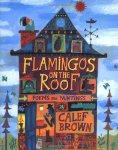
Poetry Friday - A review of Flamingos on the roof

When I try to remember which poem first showed me the joys of reading poetry, I think of The Owl and the Pussycat, which was written by Edward Lear. It is a story poem, and it is also a delightfully peculiar and sometimes funny poem. When it comes to children, funny poems are wonderful ambassadors for poetry. Amusing and nonsense poems tickle children's funny bones and they show children that poetry can be a lot of fun. Today's poetry title is packed with poems that will make children smile and laugh.

Calef Brown
Poetry Picture Book
For ages 6 to 8
Houghton Mifflin, 2006, 978-0618-56298-5
For centuries people have been writing poetry to share ideas and feelings with others, to tell stories, and to describe people and places. Often poems of this kind are serious, thought provoking, and meditative, but every so often someone comes along who likes to use poetry to make people laugh. Calef Brown is just such a person.
   In this splendid poetry collection Calef Brown gives us poems that are deliciously odd and funny. He begins with a poem called Alphabet Sherbet in which he asks us “Have you ever heard of it?” He then goes on to tells us about the “beautifully blue” B’s and the “fair” F’s that one finds in this cold, sweet, word-filled dessert.
   Many of the other poems in this book introduce us to very interesting characters, like Angus, a dog who used to wear very boring and dull clothes. Now he wears a plaid suit that he made himself and he “never takes it off.” Then there is Bob who built a chopper in a bottle, and Sally who is Medusa’s sister. As you probably know, Medusa has snakes instead of hair and if you look at her, her gaze will turn you to stone. Sally has a variation of this reptilian coiffure. She has “a single lazy snake” on her head, but instead of turning you to stone, her curse is “much worse.” Sally “makes you stop and talk.”  
   Then there are the poems that describe things such as worms, orchids, and an Allicatter Gatorpillar. An Allicatter Gatorpiller is a truly remarkable creatures. It can change its appearance and become an Allibutter Gatorfly!
   If you want to know about the TV Taxi you need go no further because a poem in this book will tell you all about it. Have you thought about replacing your birthday candles with light bulbs? If you have, you are not alone. Someone else has come up with the same idea and you can read about her in the poem Birthday Lights
   There are poems in this title that suit all kinds of personalities and moods, and throughout the book the poems are complimented by wonderfully colorful illustrations.

Thursday, February 14, 2013

Monday, February 11, 2013

Picture Book Monday - A review of A Giant Crush

Having your first real crush can be a wonderful, and sometimes painful, emotional roller coaster journey. Since Valentine's Day is only a few days away, it is fitting to share this story with you. In the story you will meet a large bunny boy who has a big crush on one of his classmates. More than anything he wants to tell his crush how he feels about her, but how is he supposed to do this? Will a Valentine's Day card solve his problem?

Gennifer Choldenko
Illustrated by Melissa Sweet
Picture Book
For ages 6 to 8
Penguin, 2012, 978-0-399-24352-3
Cooper and his friend Jackson are making Valentine’s Day cards when Cooper notices that Jackson has created a giant card, a card that is full of chocolate Kisses. Cooper asks Jackson about the card, but Jackson chooses not to respond to his friend’s question.
   On Monday Cooper notices that Jackson has a big yellow flower in his backpack in the morning and that the flower disappears before show-and-tell time. On Tuesday Jackson has some chocolate hearts in his lunch bag, but by the time they get to the cafeteria, the hearts are gone and when Cooper asks about the missing candy Jackson blushes until his cheeks are as “red as a wrong-answer pencil.”
   After school that day Cooper finally figures out that his friend Jackson likes a cute little girl called Cami. The problem is that Carter Corey also likes Cami, and he is not shy to show her how he feels. Poor Jackson is afraid to openly tell Cami that he likes her and is convinced that a cute girl like Cami could never like him, a boy who is rather large for his age.
   In this sweet Valentine’s story the talents of Gennifer Choldenko and Melissa Sweet are combined to give readers a delightful tale. As the story unfolds, we see how hard it can be to show someone how you feel about them, and how precious good friends are.

Friday, February 8, 2013

Poetry Friday - A review of We Go Together

Love and affection makes our lives richer and happier, and armed with these emotions we are stronger when times are hard. In today's poetry title Calef Brown gives us a delightful selection of poems that are about the joys of being close to someone.

Calef Brown
Poetry Picture Book
For ages 7 and up
Houghton Mifflin, 2013, 978-0-547-72128-6
Finding a true close friend who is happy to share good times (and bad times) is a not easy, and if you have such a person in your life you are truly lucky. In this collection of eighteen poems, Calef Brown pairs his unique paintings with little poems that explore friendships of all kinds. He looks at the special affection that can grow between friends and family members.
   Early on in the book we hear from two boys who feel that they “go together / like fingers and thumbs.” They are “Genuine chums” who feel that they have won “the buddy lottery” because they have each other. Then there is the dog who, when his friend rings him up on the phone, runs over to his friend’s house down busy streets “through the hurried masses.” The dog gets “more / and more pep” in his step the closer he gets to his friend’s home.
   Friends can, with just a smile, make you feel better, which is what happens to the person talking to us in the poem Scrootin’ Eyes. We read about how the narrator’s friend’s smile makes the narrator experience “heart twinkles.”
   Friends are also the perfect people to have around when something goes wrong. In the poem Thank you we read about how a person tries not to fall to pieces when he gets a splinter in his hand. He knows that his dearest person will take care of the problem with tweezers and some soothing balm.
   With touches of humor and warmth and wonderful imagery, Calef Brown gives us a collection of poems that can be shared with anyone special who makes the world a better place. Readers can dip into the book and will emerge feeling better about life. They will be reminded that there are dear people in their lives who care about them; people who share giggles, who heal hurts, and who know us so well that they know how to make us happy.
  

Monday, February 4, 2013

Picture Book Monday: A review of A Splash of Red

Usually on Picture Book Monday I review fiction picture books, but A Splash of Red, a nonfiction picture book, is so special that I decided to make it today's review title. The story tells the story of Horace Pippin, a self-taught artist who overcame many challenges to become a much admired member of the artistic community in the United States.

Jen Bryant
Illustrated by Melissa Sweet
Nonfiction Picture Book
For ages 6 to 8
Random House, 2013, 978-0-375-86712-5
On February 22, 1888, Horace Pippin came into the world. The grandson of a slave, Horace did his part to help out by doing chores and taking care of his siblings. At the end of the day, once all the work was done, Horace used to draw pictures, capturing on paper the things that he had experienced and seen during the day. He also drew pictures at school, delighting his classmates and infuriating his teacher.
   One day Horace entered a drawing contest and to his delight he won. The prize he received was a package of art supplies, and he was thrilled to own his very own colored pencils, brushes, and paints. Even when Horace had to leave school to work, he kept on creating pictures for himself and for his coworkers. Then, when World War I broke out, Horace left his home, joined the army, and went to serve his country in Europe. For days, sitting in a trench, Horace did not see the sun. When there was a lull in the fighting Horace drew pictures for himself and for his soldier friends who asked him to “Make a picture for us, Horace!”
   Then Horace was shot in the shoulder. His right hand could not move normally, nor could he use it to lift things. For the first time since he was a little boy, Horace could not paint or draw. It was as if a door to a special world had been closed in his face.
   In this remarkable picture book biography, Jen Bryant’s emotive text is paired with Melissa Sweet’s splendid mixed media artwork. On several of the pages the artist incorporates hand lettered quotes into the artwork, giving us a very personal connection with the thoughts and feelings of one of America’s great artists.
   Notes at the back of the book written by the author and illustrator give us some insight into the journey that they took, together, to find out about Horace Pippin, his work, and his legacy.

Friday, February 1, 2013

Poetry Friday - A review of I Haiku You

When today's poetry title arrived at my house I was thrilled. It was the perfect book to review in February because February is a month when many people think about and give thanks for the people they love. This book celebrates the people who make our days better, and the things that make our life sweeter. It would be a perfect book to give to that special someone.

Betsy Snyder
Poetry Picture book
For ages 5 to 7
Random House, 2012, 978-0-375-86750-7
Every day we have encounters that make our day just a little better. We meet people and animals whose love and affection makes life sweeter, who make the good times richer and the painful times more bearable. There are also things that make our lives richer and more enjoyable.
   For this sweet little poetry picture book Betsy Snyder has created some wonderful haikus that capture special moments and freeze them in time so that we might enjoy them.
   She begins by showing us a little girl who is wishing a little red bird a good morning. For her, the birds “everyday song” is her “favorite alarm clock.”
   Later in the book we meet another girl hugging her teddy bear. She thinks that her precious friend is the “best teddy ever” because it hugs “away tears” and makes all her “boo-boos” better. A teddy is only one of many things that give children pleasure. There is the child who delights in watching sunflowers grow, and for three children on a hot day there is nothing so wonderful as a glass of cold lemonade that makes their taste buds start “cheering.”
   This book gives us the opportunity to journey through a day sharing important moments with children and animals. Throughout the book the artwork beautifully compliments the image-rich haikus.

Monday, January 28, 2013

Picture Book Monday - A review of Oh No, Little Dragon!

I have a great fondness for dragons, which is why in part I chose to write Talon Diaries, a serialized story about a dragon. I am always on the lookout for new dragon books, and today's title is quite delightful. In it you will meet a little dragon who finds out that it is not wise to drink too much bath water.

Jim Averbeck
Picture Book
For ages 4 to 6
Simon and Schuster, 2012, 978-1-4169-9545-6
Little dragon is lucky because he has a “spark in his heart” that allows him to make fire. He loves being able to send fire swooshing out of his mouth into the air, and his mother happily tells her little son that she loves his flame.
   Of course, if you go around making fire, you have a tendency to become sooty. Little Dragon’s mother tells him to have a bath, and when he says that he hates baths, she tells him that he can play with his wooden boat in the tub.
   In the tub Little Dragon sends a fantastic flame across the water and sets the boat on fire. Then, he decides to be “Little Dragon Fire Department” and he does a cannonball to put out the fire he made. He laughs with delight and, not surprisingly, swallows some water, which puts out Little Dragon’s spark. He is sparkless and therefore flameless. Somehow he has to get his spark back!
   This delightful picture book will make children laugh out loud. Who can resist a little dragon who likes to set fire to things. Children will be especially amused when they see what the little dragon does to try to get his spark back.
   With wonderfully minimal but expressive illustrations and a funny story, Jim Averbeck gives readers a picture book that they will enjoy reading and looking at again and again.

Friday, January 25, 2013

Poetry Friday - A review of Poetry for Young People: Henry Wadsworth Longfellow

I must confess that I before I moved to the United States, I knew very little about Henry Wadsworth Longfellow. I am not sure why we never looked at his work when I was in school, but we didn't. Since then I have made a point of reading some of his writings and poems and have greatly enjoyed the experience. Today's poetry title not only introduces readers to some of his poetry, but the editor of the collection also tells us the story of Longfellow's life.

Edited by Frances Schoonmaker
Illustrated by Chad Wallace
Poetry
For ages 9 and up
Sterling, 1998, 978-0-8069-9417-8
Henry Wadsworth Longfellow grew up in Portland, Maine. Though his family was not wealthy, they were well off enough that Henry and his siblings got a good education and they always had access to books. Henry grew up to love the written word, and the things he saw around him inspired him to write poetry. Often his poems described people and everyday events. In one of his longer poems there is a scene where he describes a potter working at his wheel. To him, the potter’s ability is like magic as “That shapeless, lifeless mass of clay / Rise up to meet the master’s hand.” He also wrote about a village blacksmith who, with “brawny arms” that are as “strong as iron bands,” works all day long working the bellows and beating the metal with a “heavy sledge.”
   After going to college and travelling to Europe to learn foreign languages, Henry became a scholar and a teacher at Harvard. He also wrote poems when he could, including long story poems such as Evangeline, Paul Revere’s Ride, and The Song of Hiawatha.
   Then there were the poems that were more personal. Moved by the plight of slaves, he wrote eight poems that were combined in a little book called Poems on Slavery. Though his views made him unpopular with some people, Henry always felt that slavery was a terrible practice and he tried to show people what it would be like to be a slave. In The Slave’s Dream he tells the story of a slave who is thinking about his homeland in Africa, and in The Witness he gives a voice to all the slaves who drowned when the slave ship they were on sank. On the ocean bed they lie and “cry, from yawning waves / “We are the Witnesses.” They are the ones who know all about the cruelty of man against man.
   In this excellent Poetry for Young People title, the editor’s introduction sets the scene for the poetry selections that she chose to share with readers. Readers get a sense of what kind of man Longfellow was, and how his life experiences influenced his creative process. Knowing the poet’s story will help readers to better appreciate his splendid poems. 

Monday, January 21, 2013

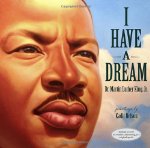
Picture Book Monday - A review of I have a Dream


Today Americans remember the life of one of our greatest citizens: Martin Luther King Jr. He was born on January 15th in 1929, and was assassinated on April 4, 1968. Martin Luther King Jr. gave many powerful and moving speeches in his lifetime, but probably the most famous one is the speech he gave in Washington, D.C on August 28, 1963. On that day he told thousands of people about his hopes and dreams, and in today's picture book his beautiful words are paired with Kadir Nelson's artwork to give readers of all ages a memorable book experience. 

Dr. Martin Luther King Jr.
Illustrated by Kadir Nelson
Nonfiction Picture book and Audio CD
For ages 6 and up
Random House, 2012, 978-0-375-85887-1
On August 28, 1963, Martin Luther King Jr. stood in front of the statue of Abraham Lincoln in Washington D.C. In front of him was a sea of people, people of many races and followers of many faiths.  He had been working as an activist and leader in the African-American struggle for civil rights for many years, and leading “The Great March on Washington” was a big moment for King and his cause.
   King took on the cause of the civil rights movement in 1955 when he led the Montgomery Bus Boycott, and in subsequent years King’s family members were threatened and he was thrown in jail. Supported by his faith, his followers, and his belief in his cause, he managed to overcome his fears and concerns to lead his people in peaceful marches, boycotts, demonstrations, and sit ins.
   King began his famous speech on that hot August day by talking about how the Negro in America was still not free, despite Abraham Lincoln’s Emancipation Proclamation, and despite the fact that the Declaration of Independence says that “all men are created equal.”
   Later in the speech he shifted his focus and said “I have a dream…” and he told his listeners all about this powerful dream, his hopes for all Americans.
   In this beautiful picture book the latter half of King’s memorable speech is shared with young readers. Two minor changes have been made, and one paragraph of the original speech has been left out, but otherwise King’s words have been left untouched.
   Accompanied by Kadir Nelson’s beautiful art, the text is as powerful today as it was all those years ago, and even young children will recognize the beauty in King’s words.
   At the back of the book readers will find a copy of the entire speech, and an audio recording of King giving his speech can be found on the CD that comes with the book.
   
Bookmark and Share