Tuesday, January 26, 2016
Lets get the winners of the children's literature awards on the Ellen Show!
Not long ago the American Library Association announced the winners of America's most prestigious children's book awards, which includes the Caldecott Award and the Newbery Award. Many of us in the children's literature world would love to see the winners of these awards on the Ellen Show. The staff at KidLitTV have created a short movie about their campaign that I would like to share with you.


Monday, January 25, 2016
Picture Book Monday with a review of This is Not my Hat

When I was growing up, I was naturally drawn to stories that featured children who broke the rules. Eloise, and many of the 'naughty' characters from Roald Dahl's books were my heroes because they prevailed in spite of everything. In today's picture book you will meet a fish who does something bad. He knows that what he is doing is wrong, but he does it anyway. The ending is rather surprising, and perfectly perfect, under the circumstances.
This is not my hat
Jon Klassen
Picture Book
For ages 4 to 6
Candlewick Press, 2012, 978-0-7636-5599-0
One day a very small fish steals a hat from a very large
sleeping fish. The small fish thinks that the large fish “probably won’t wake
up for a long time,” and even when he does wake up the fish won’t notice that
the hat is gone. After all, the hat is very small and the big fish probably
barely felt it.
Just in case,
the little fish decides to hide in a place where the plants are “tall and close
together.” A crab sees where the little fish is going but it promises not to
tell anyone where the little fish is hiding. The little fish justifies the
theft of the hat, which he knows was a bad thing to do, because the hat was too
small for the big fish.
The little fish
makes it to his hiding place and swims in amongst the plants. He is so sure
that “Nobody will ever find me,” but it turns out that many of the assumptions that
he made were completely wrong.
This beautifully
crafted book, with its simple tale and cocky main character, will delight young
readers. Children will be able to see how wrong the little fish is as he talks
about what he has done and how to plans to get away with the theft of the hat.
They will see that the little fish’s confidence and optimism is, alas,
misplaced.Friday, January 22, 2016
Poetry Friday with a review of The Way the Door Closes
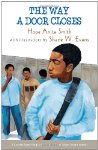 Life is full of unknowns. Sometimes even the things that you feel sure about are not as secure as you thought they were. One of the hardest things for children to cope with is when something happens to a parent. When there is a divorce, when a parent dies, or when a parent walks out, the ramifications for the children in the family can be considerable. Today's poetry title takes readers into the heart and mind of a young man whose father leaves suddenly. The narrative is moving and powerful, and it shows readers what it is like to be a child who is trying to cope with this kind of devastating event.
The way a door closes
Hope Anita Smith
Illustrated by Shane W. Evans
Poetry
For ages 10 to 13
Henry Holt, 2011, 978-0312661694
C.J. lives with his Momma, Daddy,
Grandmomma, and his younger brother and sister. On the whole they have a happy
life together, and C.J. admires his strong grandmother, his beautiful mother,
and his dependable father who reminds C.J. to be proud of who he is. He loves
Sunday afternoons, when he and his father and brother go out and do something
together, just the three of them.
Then Daddy loses his job and things start to change. Daddy tries not to
show his pain and worry, but C.J. still sees it and every day he prays that his
father will finally get a job. Every day Daddy comes home without a job. Then,
one night, Daddy tells his family that he is going out. Somehow, the way he
closes the door makes C.J. feel as if they are “vacuum-sealed inside” the room.
Something about the way that Daddy closed that door feels wrong.
Sure
enough, that night and the next day Daddy does not come home and C.J. offers to
get a job, to even leave school “until we get things squared away,” but Momma
won’t hear of it. In fact she gets angry and slaps her son, only to hold him
close and cry. As far as she is concerned C.J is too young “to be a man.”
As
the days go by, the gloom of Daddy’s absence spreads, and it touches everyone
in C.J’s household. People start to think that Daddy is just another dead-beat
dad who will never come back.
Written using a series of blank verse poems, this touching book explores
how a teenage boy feels when his father abandons his family. Feelings of
disbelief, anger and fear swirl through C.J. as he tries to come to terms with
the fact that nothing stays the same, and that even strong and loving fathers
can get afraid when life deals them a blow.
Monday, January 18, 2016
Picture Book Monday with a review of The Red Apple
Learning how to work with others and cooperate is a lesson many children struggle with. They often prefer to do things their way. If there is a prize to be earned, they don't want to share it. They would rather struggle on their own than cooperate with others if it means that they have to share the prize. In this gorgeous picture book we see how a group of animals work together to try to get something and how, in the end, their cooperation gives them a gift that none of them expected.
The red Apple
The red Apple

Picture Book
For ages 4 to 6
Minedition, 2015, 978-988-8240-00-5
One snowy, bitterly cold winter’s day a rabbit leaves his
burrow to try to find some food. Unfortunately, the snow is so deep that everything
edible is buried. Then Rabbit sees a bright red apple hanging on a bare tree.
Rabbit is delighted with his find and he quickly goes over to the tree. Only to
discover that the apple is too far above his head. There is no way that Rabbit
can reach the precious fruit.
Rabbit decides
to ask Mouse for his help, and Mouse is willing to do what he can, but it turns
out that the tree is too big for such a small mouse to handle. Even when Mouse
stands on Rabbit’s head the apple is still too high for them to reach it.
Then Fox, who is
feeling “a bit under the weather,” arrives on the scene. He tries to knock the apple off the tree with
his tail, but his efforts are no more successful than the earlier ones were,
and the apple, very stubbornly so it seems, stays firmly attached to the tree.
In this
beautifully written and visually stunning picture book, Feridun Oral shows his
readers how cooperation sweetens life in more ways than one. The ending will
warm the hearts of readers of all ages.
Friday, January 15, 2016
Poetry Friday with a review of A Spectacular Selections of Sea Critters

Concrete poems give poets a means to entertain readers with word magic and graphic art magic. I encountered this form of poetry relatively recently and have seen first hand how excited young children become when they see how the words in a poem can be used to create a picture. This wonderful book is packed to the gills with lots wonderful concrete poems that tickle the mind and delight the eye.
A spectacular Selection of Sea Critters
Betsy Franco
Illustrated by Michael Wertz
Poetry Picture Book
For ages 6 to 8
Lerner, 2015, 978-1-4677-2152-3
Many people love spending time at the seaside, paddling
in the waves, and exploring ocean worlds. They are fascinated by the creatures
that live underwater; the fish, turtles, jellyfish, stingrays, eels and other
animals.
In this
delightful book Betsy Franco’s clever concrete poems are paired with wonderful
artwork to give readers a memorable journey into the world of sun, sea, sand,
and “sea critters.” The words on the pages are arranged to create shapes and
patterns that reflect what is being said in the poems, and these arrangements
of words perfectly complement the illustrations to give readers a singular
reading experience.
We begin with a
piece of poetry called Sun Mail. The warmth
of the sun is sending us an invitation to go “Snorkling today!” and when we dip
our heads beneath the ways we see schools of fish where all the fish move in
perfect unison to the right, the left, up and down. The fish “shift together in
a flash” and as one “they swim together to survive.”
In the water we
encounter box jellyfish, “fascinating” creatures that move around by
“undulating” and “pulsating.” We see a sea turtle “row by” with “flippered
wings,” and a king angelfish, which is territorial about her space. Among the
coral, butterfly fish spend their days “floating, flitting, flickering,
fluctuating feeding.” The peaceful harmony of their world is rudely interrupted
when they have to flee from a hungry eel.
Puffer fish,
cleaner fish, needlefish, sea horses, Moorish idols, trumpet fish and others
cover the pages of this special book. There are poems in rhyming verse, blank
verse, a haiku, an acrostic poem, a tercet, a limerick, a riddle and more.
Throughout the book Betsy Franco dazzles us with her remarkable word pictures
and delights us with her creativity.Monday, January 11, 2016
Picture Book Monday with a review of Sanctuary
Some picture books were clearly written just for children. Others will appeal to adults who love to look at beautiful art, or who like to give their imagination an airing. And then there are picture books that can be enjoined equally by children and adults because the message is so universal. Today's picture book is just such a title. Children will be drawn into the simple narrative and perhaps they will think about what makes them feel safe and secure. Adults may find themselves wondering what their sanctuary is too. Is it a place, a person, or something else altogether?
 Sanctuary
Sanctuary
Wendy Marloe
Illustrated by Joanna Chen
Picture Book
For ages 6 and up
Marloe Press, 2015, 978-0-9823495-3-3
When a group of people are asked what they think of when
they hear the word “sanctuary,” each person will probably come up with a unique
answer. For some, a cozy nook in a window seat might be a sanctuary, while for
others their sanctuaries might be out in the fresh air, perhaps amongst trees
in the woods or on top of a high hill.
In this
memorable book a minimal text is paired with beautiful illustrations to explore
what sanctuaries are. They can be places where we share a part of ourselves, places
like a stage. Or they can be places where we can be alone, such as a chair in a
library. A sanctuary can be a structure “made out of stone, or cloth, or
cardboard or wood,” or alternately it can be “the space between here and the
horizon.”
A sanctuary can
be a solitary place under the covers where we hold onto a beloved stuffed
animal so that we can have a quiet cry, or it can be picnic place in the woods
where we go to play and laugh with others.
This is the kind
of book that children and grownups alike will enjoy sharing. It is a book that
will give readers something to think about, and they will enjoy sharing the
artwork, and the imagery in the words, with others.
Friday, January 8, 2016
Poetry Friday with a review of We troubled the waters
Until relatively recently, I had never encountered poetry that told uncomfortable stories from real life, stories that captured painful events from history. Then I started reviewing poetry books and I came across a few such titles, books in which the raw truth from the past is shared and explored. Today's poetry title is an example of this kind of book, and the poems it contains are powerful and honest.
We troubled the waters
 Ntozake Shange
Illustrated by Rod Brown
Poetry Picture Book
For ages 8 to 10
HarperCollins, 2009, 978-0-06-133735-2
The history of the African American people is peppered
with stories of struggle, loss, landmark moments and people of great courage. We
know some of these stories well and think about them as the year rolls around,
remembering how Rosa Parks took a stand on a bus, and how Martin Luther King
Jr. gave a speech on a hot summer’s day in Washington D.C. However, there are
many stories that we do not know, and in this book big stories and small ones
are told to help us get a truthful picture of what it was like to be an African
American in the days when people of color were discriminated against.
The first story
we encounter is about the schools Booker T. Washington founded, schools that
gave black children the tools, it was hoped, that would allow them to succeed
in the world. Not many years before, the children who attended the schools
would have been horribly punished for trying to get an education, but now the
door to the world of books, words and numbers was open to them.
Soon after we
read this story of hope we meet a woman sitting in the middle of a floor. She
is a “Cleaning Gal” and she knows that she could get into terrible trouble for
resting when she should be working. She knows that many tasks await her in the
hours and days ahead, and that she has to work, and work hard, to provide for
her family. She knows that while she labors away, her employers will live a
life of leisure, a life she can only dream about.
Though this is
painful and sad picture, it is nothing compared to the one we come across later
in the book when we read about how a group of boys are lynched, left hanging in
trees for the their family members to find. Often these acts of barbarism were
the work of the Ku Klux Klan, a group who “terrorized” African Americans for
generations. Wearing their white robes and head coverings “they took no
responsibility for the heinous reign of death they dealt.”
We read too
about how many brave souls refused to accept the “WHITES ONLY” signs. They
protested peacefully against segregation in five and dime stores and other
places where they were not welcome, and were attacked and imprisoned for their
pains.
This powerful
collection of poems will give readers a sense of what African Americans went
through, and how they suffered over the years, oppressed by violence and Jim
Crow laws. They were not beaten though, and rose up to march and sing, to speak
and to shout out for justice.
Monday, January 4, 2016
Picture Book Monday with a review of Tree: A little story about big things

Many people have a hard time understanding why some adults love children's literature. Why would a grownup like to look at picture books, which are childish and surely too simple for an adult reader?
It is true that some picture books have a simple story line, one that caters just for children, but there are others that present readers with a bigpicture concept, a story that explores a universal principal that will resonate with readers of all ages.
Today's picture book is just such a title, and it is one that I have put on my to-look-at-again-and-again shelf. It is book that is beautiful on many levels.
Tree: A little story about big things
Danny Parker
Illustrated by Matt Ottley
Picture Book
For ages 5 and up
Little Hare, 2012, 9781742978604
A little seed lands in the shelter of a big tree’s curved
roots, and there it germinates and sprouts. Though it is “delicate and frail”
the little tree begins to grow. Sheltered by its large and strong neighbor from
the baking sun, heavy rains and snow, the little tree flourishes. And then, one
night, a terrible storm blows through, and though it has withstood many a storm
before, this time the older tree, the little tree’s protector, is not able to
withstand the ferocity of the wind, rain and lightning.
When the “uproar
and confusion” passes, and the quiet returns, something is different in the
little tree’s world. Its protector is gone. Big machines rumble and roar around
the little tree and it is left to struggle in a wasteland without any other
tree around or near it.
Loss and change
can be devastating, whether you are a tree or an animal or a person. With minimal
text and incredibly beautiful illustrations the author and illustrator of this
remarkable picture book helps readers to see the cycle of life, death and
renewal in a powerful and life-affirming way. We see how the older generation
protects the younger until the younger has to stand on its own and face what
life sends its way.Friday, January 1, 2016
Poetry Friday with a review of Bow-Tie Pasta: Acrostic Poems

I had never seen an acrostic poem until my daughter wrote one at school and proudly showed me her creation. She went on to write many more such poems, and still occasionally writes acrostics, which she illustrates with her own drawings. This wonderful title shows young readers how these poems are written, and provides them with examples to read and enjoy.
Bow-Tie Pasta: Acrostic Poems
Brian P. Cleary
Illustrated by Andy Rowland
Poetry
For ages 6 to 8
Millbrook, 2015, 978-1-4677-8107-7
For many children, an acrostic poem is the first poem
that they write. To create these poems poets use a word, written down the page
instead of across it, to form the building blocks of their word creation. They
then begin to write phrases that begin with the letters of that word that
explore, in some way, what that chosen word means. For example, the first poem
in this is book is built off the word “Acrostic.” The first letter of the first
line is an A, the second a C, the third an R, and so on. The poem begins thus:
“All kinds of poems are / Cool, but this type is / Really interesting…” Since rhyme and
meter patterns are not required in poems of this type - though some of them do
rhyme - acrostic poems are wonderfully simple to create.
The author of
this book begins by explaining what acrostic poems are and then he gives us
some wonderful examples to read and explore. Some of the poems use only one
word, words like piano, Halloween, and library. Other poems use several words.
For example, the author creates a poem called Bow Tie Pasta and the poem explores what it is like to eat pasta
that is made out of bow ties of all colors. Not surprising, the meal is “Awful
tasting.”
Many of the
poems are written without any kind of rhyme or pattern, but there is one that
has rhyme and a balanced meter. The poem is called Rainy Day, and as the verse unfolds we read about a child who makes
“cookies by the sheet / Next they cool. I dunk and eat.” Thanks to books,
treats, and games, this is a boy or girl who loves “the great indoors!”
Children who
have been afraid to try writing poems of their own are going to be inspired
when they look through this book. They will see how easy it is to write
acrostic poems, which can be funny, tell a story, or be contemplative,
depending on the writer’s mood.
Monday, December 28, 2015
Picture Book Monday with a review of Grant and Tillie Go Walking
I must confess that other than being able to recognize American Gothic, until recently I did not know much about Grant Wood's art. I did not know his story either. I was therefore very keen to read and review today's picture book title, which provides readers with a very unique, partially true, tale about Grant Wood's life. The story is touching and sweet, and it piqued my interest so much that I then went online and read about Grant Wood some more.
Grant and Tillie Go Walking
 Monica Kulling
Illustrated by Sydney Smith
Picture Book
For ages 5 to 7
Groundwood Books, 2015, 978-1-55498-446-6
Grant Wood lives on a farm, and many days he goes walking
with Tillie the cow. Tillie is happy with her lot in her life. She has a
comfortable home, plenty to eat, and she has Grant. Unfortunately, her human
friend is not happy. Grant is an artist at heart and he feels that he belongs
somewhere where he will find “more excitement,” a place like Paris where French
artists create their works of art.
And so Grant
leaves his farm life and travels to Paris with his friend Marvin. One evening
the two artists climb to the top of the Eiffel Tower and see the city lying
below them, “lit up like fireworks.” Grant no longer wears his farm overalls.
Instead, he dons city clothes and a beret. He grows a beard and spends many
hours talking to other artists in cafes.
Grant and Marvin
paint outdoors, creating paintings in a style that is new and exciting.
Marvin’s creations sell quickly, but Grant’s do not. For some reason he is not
able to connect with Paris in a meaningful way, and when he tries to paint a cow
– something that is familiar to him - that does not work either.
Back at home, on
the farm, Tillie is missing Grant terribly. She loses interest in her food, and
she does not go for walks anymore because she does not have Grant to show her
the way. Tillie grows sad and thin, and Grant’s family members do not know what
to do to help her.
In this
delightful picture book Monica Kulling weaves together fact and fiction to give
readers a heartwarming story about an artist who has to leave home to find out
what kind of an artist he is. Children will be delighted to see how Grant and
Tillie both get something priceless from their relationship.
In an author’s
note at the back of the book readers will find further information about Grant
Wood and his art.
Friday, December 25, 2015

Poetry Friday with a review of Little poems for tiny ears
It is so wonderful to share poetry with little children. The rhyme and rhythm feels natural to them, and they are happy to enjoy poems without needing to understand the exact meaning of every word. Theirs is an organic appreciation which anyone who loves the written word can appreciate.
Today's poetry title was written just for little children and it is delight to share.
 Little poems for tiny ears
Today's poetry title was written just for little children and it is delight to share.
Little poems for tiny ears
Lin Oliver
Illustrated by Tomie dePaola
Poetry Picture Book
For babies and toddlers
Penguin, 2014, 978-0-399-16605-1
Sharing poetry with babies, crawlers and toddlers can be
so much fun as children who are this young have a natural affinity for the
sing-song cadences of verse. Even if they are too young to fully understand the
words, there is something about the sounds in poetry - which are similar to the
ebb and flow found in music - that little children love.
In this book Lin
Oliver gives his readers a delightful collection of poems that were written
with very young children in mind. On these pages we will meet a little girl who
sees a baby in the mirror and who marvels at the way in which the mirror baby
copies everything she does. Another little one tries walking and he is not
discouraged when he falls down. After all, if he does fall down all that
happens is that he lands “on my behind.”
Further along in
the book we encounter a little baby who is going out for a walk in his
stroller. From his vantage position, being pushed by a grownup, the baby sees
two cats and a dog. He sees a girl jogging and waves to her.
Other poems talk
about noses, toes and tongues. We hear about dogs, who “give me love that never
ends,” and cats, who are “silky, soft and furry.” There are poems about bath
time and diaper time, a poem about a blankie and a poem about “daddy’s beard.”
In short, on these pages readers will find poems that perfectly capture a
little child’s world.
Throughout the
book Tomie dePaola’s warm and cozy illustrations perfectly complement Lin
Oliver’s poems.Sunday, December 20, 2015
Picture Book Monday with a review of When it Snows
When I first looked at today's book I had no idea that the story within was remarkable. I was naturally drawn to the art, which is gorgeous, and I certainly expected the story to be a beautiful winter tale. In actual fact it is a lot more than that. The minimal story is also very powerful, and it reminded me of why I do what I do.
 When it snows
When it snows
Richard Collingridge
Picture Book
For ages 5 to 7
Random House UK, 2012, 978-1-849-92140-4
It has snowed and now the cars are stuck and the train
has “disappeared” under a mantel of soft whiteness. A little boy is outdoors
and with his teddy bear in hand he follows the footprints in the snow. Then he
gets a ride on the back of a white bear for a while. Eventually he comes to the
place “where the snowmen live.” There are dozens of snowmen standing under the
snow-filled clouds, many of which are being built by other children.
When the sun
sinks the little boy leaves the snowmen behind as he follows a bright light
that leads him to a forest. There the Queen of Poles takes the boy to a secret
place where he sees all kinds of wondrous things.
Throughout this
book a spare text is paired with luminous illustrations to take children on a
remarkable journey. The journey itself is magical, but the way in which it ends
is, if possible, is even better because we discover that the boy can go to the
places we saw in the story “every day” if he wishes because he has something
that makes this possible.
Though this book
certainly has a wintry, festive feel to it, readers will be drawn to it again
and again, even when the days are long and warm.Friday, December 18, 2015
Poetry Friday with a review of Winter Eyes.
In just a few days it will be the winter solstice, the longest day of the year. I love celebrating the solstice as I feel the day connects me to my ancestors, for whom the solstice was a time of reflection and celebration. It was also the beginning of a season that was often hard and taxing.
Today I bring you a review of a winter poems book that I thoroughly enjoyed, and I hope you will enjoy the book too.
 Douglas Florian
Today I bring you a review of a winter poems book that I thoroughly enjoyed, and I hope you will enjoy the book too.
Winter Eyes

Poetry Collection
Ages 5 to 8
HarperCollins, 1999, 0-688-16458-7
There are so many
wonderful things to look forward to in the winter time. There are frozen lakes
to skate on, holidays to celebrate, hot cocoa to sip, and nights to spend
sitting in front of the fireplace. There are also certain things about winter
which we are less keen on like having frozen toes, getting colds, shoveling
snow for hours, and having less time to play outdoors because of the shorter
days.
In this collection
of twenty-eight poems the author perfectly captures the atmosphere, the joys,
the woes, and the celebrations of this season. He describes time spent toasting
toes in front of a fire; he ‘paints’ pictures in words of animal tracks in the
snow and icicles hanging from the eves. He has created poems that rhyme and
poems that do not. He has also created poems which tell a story not only
through the words themselves but also by the way those words are arranged on
the page. The poems are funny, poignant, descriptive, and expressive and
together they present the reader with a charming portrait of wintertime.
Tuesday, December 15, 2015

Monday, December 14, 2015
Picture Book Monday with a review of Mother Bruce
Motherhood is full of surprises. I know that there were many experience that I was not expecting when I became a mother, some of which were hard, and some of which were delightful. I can only imagine what it would be like to experience these things if one is not expecting to be a mother at all. In this picture book you will meet a very grumpy male bear who ends up becoming a mother. A reluctant mother it is true, but a mother nonetheless.
 Mother Bruce
Mother Bruce
Ryan T. Higgins
Picture Book
For ages 5 to 7
Hyperion, 2015, 978-148473088-1
Bruce is a grumpy bear who lives by himself. He does not like sunny days, or rainy days,
or cute little animals because he is such a big grump about just about
everything. The only think Bruce does like is eggs. He goes out and collects
them and then cooks them, using “fancy” recipes that he finds on the Internet.
One day Bruce
decides to make boiled goose eggs drizzled with honey-salmon sauce. He gets
some salmon and honey and then steals four of Mrs. Goose’s eggs. Bruce starts
to prepare his boiled eggs when the fire in his stove goes out. By the time he
gets wood to stoke up the stove the four eggs have hatched and the little
goslings think that Bruce is their “MAMA!”
Bruce is very
disgruntled by this unexpected turn of events. He prepares goslings on toast
but for some reason cannot seem to eat the goslings, who look at him
questioningly. Bruce then tries to take the goslings back to their mother, but
she has headed south early and her nest is empty. Bruce leaves the goslings in
the nest and heads for home, and the goslings follow him. Bruce tells them that
he is not their mother. He runs away. He climbs a tree. Nothing he does makes
the slightest bit of difference. As far as the goslings are concerned, Bruce is
their mother, even if he “is a HE and HE is a bear.”
This hilarious
picture book explores how one very grumpy bear ends up becoming the mother of
four very demanding goslings. Bruce dearly regrets the day when his meal
hatched, but there is nothing that he can do except to make the best of things.
Which is what he does, bless his grumpy bearish heart.Monday, December 7, 2015
Picture Book Monday with a review of Quest by Aaron Becker
In 2013 a wordless book called Journey was published, and it has brightened the lives of readers all over the world ever since. Journey is a timeless, ageless book that excites the imagination. The creator of Journey then went on to write a sequel, which carries on where the tale in Journey leaves off. I am thrilled to be able to bring you a review of that sequel today.
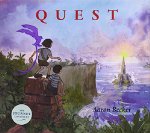 Quest
Quest
Aaron Becker
Wordless Picture Book
For ages 6 and up
Candlewick Press, 2014, 978-0-7636-6595-1
Two children are out riding a tandem bike together when it starts to rain. They, and their purple pet bird, take refuge under a bridge and they are standing there looking out when the girl notices that there is a door under the bridge. The door opens and an elderly king comes out. He gives the children a map, and a yellow crayon. Then some soldiers come out of the door and they drag the king away and slam the door behind them.
Wanting to follow the old king, the children draw a set of keys using their own red and purple crayons. They open the door and enter the world that lies beyond. They arrive just in time to see the king being taken away on a boat that is traveling away from a walled and fortified city. Parts of the city are on fire and there are soldiers everywhere. Clearly some kind of conflict has occurred and the king has been taken prisoner.
The children are spotted by soldiers, so they quickly draw pictures of a purple octopus and some diving gear. The children put on their helmet, air tanks, and swimming fins and then the octopus takes them deep under water to an ancient city, where they find another crayon, a yellow one this time. The children then swim away as quickly as they can and head for land once more.
Using the map, the children travel long distances to collect all the crayons that are shown on the old king’s map. All the while the king’s enemies pursue them relentlessly.
This magical wordless tale carries on where Aaron Becker’s first book, Journey, left of. The story can be enjoyed as a stand-alone tale or as part of a bigger narrative. Readers of all ages will delight in sharing the adventure that the two children have. Children who cannot yet read can follow the story without needing any help; and readers who are already excellent readers will love the way this book gives them the freedom to craft their own story for a change.
QuestAaron Becker
Wordless Picture Book
For ages 6 and up
Candlewick Press, 2014, 978-0-7636-6595-1
Two children are out riding a tandem bike together when it starts to rain. They, and their purple pet bird, take refuge under a bridge and they are standing there looking out when the girl notices that there is a door under the bridge. The door opens and an elderly king comes out. He gives the children a map, and a yellow crayon. Then some soldiers come out of the door and they drag the king away and slam the door behind them.
Wanting to follow the old king, the children draw a set of keys using their own red and purple crayons. They open the door and enter the world that lies beyond. They arrive just in time to see the king being taken away on a boat that is traveling away from a walled and fortified city. Parts of the city are on fire and there are soldiers everywhere. Clearly some kind of conflict has occurred and the king has been taken prisoner.
The children are spotted by soldiers, so they quickly draw pictures of a purple octopus and some diving gear. The children put on their helmet, air tanks, and swimming fins and then the octopus takes them deep under water to an ancient city, where they find another crayon, a yellow one this time. The children then swim away as quickly as they can and head for land once more.
Using the map, the children travel long distances to collect all the crayons that are shown on the old king’s map. All the while the king’s enemies pursue them relentlessly.
This magical wordless tale carries on where Aaron Becker’s first book, Journey, left of. The story can be enjoyed as a stand-alone tale or as part of a bigger narrative. Readers of all ages will delight in sharing the adventure that the two children have. Children who cannot yet read can follow the story without needing any help; and readers who are already excellent readers will love the way this book gives them the freedom to craft their own story for a change.
Friday, December 4, 2015
Poetry Friday with a review of D Is for Drinking Gourd: An African American Alphabet
Since I started reviewing books I have noticed that publishers, authors and illustrators have been finding ways to create interesting alphabet books that can appeal to readers of various ages. We still see simple "A is for Apple" type alphabet books, but we also find more sophisticated books in this genre on the shelves as well. Today's poetry book is actually a combination of poems and nonfiction text, and it looks at many aspects of African American history and culture.
 D Is for Drinking Gourd: An African American Alphabet
Nancy I. Sanders
Illustrated by E.B. Lewis
Poetry and nonfiction picture book
For ages 6 to 9
Sleeping Bear Press, 2007,978-1585362936
Often it is hard to get a real feel for the story of the African American people. We get bits and pieces of stories from biographies and histories, but the picture is a fragmented one. Now, thanks to this book, readers can start to fill in some of the gaps. They will read about the Buffalo Soldiers and African American cowboys. They will read about the African Americans who fought in the American Revolutionary War. They will discover that America's music, literary, and art scene was greatly influenced by the Harlem Renaissance – a time in the 1920s when African American poets, writers, musicians, and artists came together in New York City to create music, art, and books.
For each letter of the alphabet the author of this special alphabet book describes some aspect of African American culture or history. Some of the entries cover topics that will be familiar, such as "A is for abolitionists" and "L is for Little Rock Nine." Other entries will allow readers to see that there is so much more to the African American story. There are scientists, musicians, artists, leaders, athletes, and so many other people who have left their mark on our world. African Americans have been an important part of our society and we need to remember and be thankful for all that they have done and achieved.
For each entry in this celebratory book, readers will find an illustration, a short poem, and a longer piece of descriptive prose. The book can therefore be enjoyed on several levels ; the poems and artwork suiting younger readers, and the longer more involved sections of text being suitable for older readers.
This is one in a growing collection of alphabet books published by Sleeping Bear Press. Other subjects covered include space, China, cats, dogs, Canada, and Ireland.
D Is for Drinking Gourd: An African American AlphabetNancy I. Sanders
Illustrated by E.B. Lewis
Poetry and nonfiction picture book
For ages 6 to 9
Sleeping Bear Press, 2007,978-1585362936
Often it is hard to get a real feel for the story of the African American people. We get bits and pieces of stories from biographies and histories, but the picture is a fragmented one. Now, thanks to this book, readers can start to fill in some of the gaps. They will read about the Buffalo Soldiers and African American cowboys. They will read about the African Americans who fought in the American Revolutionary War. They will discover that America's music, literary, and art scene was greatly influenced by the Harlem Renaissance – a time in the 1920s when African American poets, writers, musicians, and artists came together in New York City to create music, art, and books.
For each letter of the alphabet the author of this special alphabet book describes some aspect of African American culture or history. Some of the entries cover topics that will be familiar, such as "A is for abolitionists" and "L is for Little Rock Nine." Other entries will allow readers to see that there is so much more to the African American story. There are scientists, musicians, artists, leaders, athletes, and so many other people who have left their mark on our world. African Americans have been an important part of our society and we need to remember and be thankful for all that they have done and achieved.
For each entry in this celebratory book, readers will find an illustration, a short poem, and a longer piece of descriptive prose. The book can therefore be enjoyed on several levels ; the poems and artwork suiting younger readers, and the longer more involved sections of text being suitable for older readers.
This is one in a growing collection of alphabet books published by Sleeping Bear Press. Other subjects covered include space, China, cats, dogs, Canada, and Ireland.
Wednesday, November 25, 2015

Monday, November 23, 2015
Picture Book Monday with a review of Strictly no Elephants
When I was in elementary school, a group of boys who I played with decided to form a boy's only 'club.' I was told very firmly that I could not be a member and that I should "buzz off!" Needless to say, my feelings were very hurt by this rejection.
When I read today's picture book I was reminded of that time when being excluded made me feel so alone. This book explores what it is like to be left out, and we see how some children deal with the problem.
 Strictly No Elephants
When I read today's picture book I was reminded of that time when being excluded made me feel so alone. This book explores what it is like to be left out, and we see how some children deal with the problem.
Strictly No Elephants
Lisa Mantchev
Illustrated by Taeeun Yoo
Picture Book
For ages 4 to 6
Simon and Schuster, 2015, 978-1-4814-1647-4
Having a little pet elephant in your life is wonderful,
but an elephant is such an unusual pet that sometimes it can cause a problem
because you “never quite fit in.” The truth of the matter is that no one else
has a pet elephant. All the neighbors have dogs, cats, fish and birds. In other
words, they have traditional pets.
Not fitting in
exactly what happens to one little boy and his pet elephant. Every day the little
boy takes his pet for a walk, and when the elephant refuses to cross the cracks
in the pavement because he is afraid of them, the little boy picks up the
elephant and carries him across the cracks because that is what friends do for
each other; they help each other out.
One day the
little boy dresses himself and his elephant in red scarves and they head out
for Number 17 because it is Pet Club Day. When they get to the little green
house they see that there is a notice on the door and it reads: “Strictly no
elephants.” The boy and his pet are truly upset by this and they walk off in
the rain, sadness resting on their shoulders. Then they see a girl who is
sitting on a bench. The girl has a skunk in her lap and the boy learns that the
other children don’t want her to join their games either. The boy then suggests
that they should start their own pet club, one that will be all inclusive.
With sweetness
and gentle humor this picture shows children how painful it is to be left out
when you are different in some way. Thankfully, the little boy in this story is
not as alone as he thinks he is, and he and his new friend find a solution to
their problem.
Children will
love the charming illustrations and cunning animal characters in this book, and
grownups may find that odd questions start popping up around the dinner table.
Questions like, “Can I get a pet elephant?” and “Where can you buy a pet
skunk?”Friday, November 20, 2015
Poetry Friday with a review of Over the River and Through the Woods: A Thanksgiving Poem
Thanksgiving is less than a week away, and in my household preparations have already begun for the big day. Shopping lists have been made, a menu has been planned, and firewood has been chopped. We plan on doing our shopping tomorrow and then all we have to do is wait for our out of town guest to arrive and cook the meal.
Being able to spend Thanksgiving with friends and family is what makes the day special for me, which is why I chose to share today's poetry title with you. The poem is more than a hundred years old and yet it still resonates with readers of all ages. It is a wonderful celebration of the times that we spend with the people we love, and the little life adventures that we share with them.
 Over the River and Through the Woods: A Thanksgiving Poem
Lydia Maria ChildBeing able to spend Thanksgiving with friends and family is what makes the day special for me, which is why I chose to share today's poetry title with you. The poem is more than a hundred years old and yet it still resonates with readers of all ages. It is a wonderful celebration of the times that we spend with the people we love, and the little life adventures that we share with them.
Over the River and Through the Woods: A Thanksgiving PoemIllustrated by Christopher Manson
Picture Book
For ages 5 to 7
NorthSouth, 2014, 978-0735841918
A little boy and his parents are setting out for his grandparent’s house on a cold snowy day riding in a sleigh pulled by a "dapple-grey" horse. Bells jingle and as they drive on the well-known road, and the boy sees children playing on the ice, a boy fishing on the ice, a man pulling a load of firewood up a hill, and the blacksmith working in his forge.
Best of all, the boy soon sees "Grandmother’s cap" and it isn’t long before the family is sitting down together for a delicious Thanksgiving feast.
Lydia Maria Child wrote this poem in the mid 1800’s and it has remained a firm Thanksgiving favorite since that time. This beautifully illustrated version of the first six verses of the poem brings to life the special celebratory feel that we all enjoy on Thanksgiving Day. The illustrator also gives the reader an intimate look at what life was like in the country on a cold winter’s day in nineteenth century America. The richly colored and textured woodcuts beautifully complement the lyrical rhyming text.
Monday, November 16, 2015
Picture Book Monday with a review of Moletown
Every so often I come across a picture book that will appeal to both children and adults. Today's picture book is just such a title. It is mostly wordless, and the artwork is incredibly rich and detailed. Adults will see that the story is similar to our own human story, and they will appreciate how the moles in the tale come to understand that they need to take responsibility for their own environment. There is a cautionary note to the tale that children and adults will recognize and hopefully learn from.
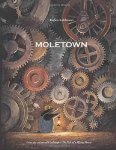 Moletown
Torben Kuhlmann
MoletownTorben Kuhlmann
Picture Book
For ages 5 and up
North South, 2015, 978-0-7358-4208-3
One day a mole set up house, underground of course, in
the middle of a beautiful green meadow. At first he was alone but soon other
moles arrived and they began digging homes for themselves as well. As the mole
community grew, so did the mole’s technological advances. They invented
machines that could convey loads of earth to the surface, and they built a
digging device that could dig tunnels for the moles so that they did not have to
do the hard manual labor themselves any longer. Soon several little mounds of
earth were scattered across the meadow.
It wasn’t long
before the moles had created a whole world for themselves underground, complete
with trains to convey moles around the town (that moved horizontally and
vertically) and huge digging machines. The moles now had TVs, sound and gaming
systems, telephones, and all kinds of other devices. The also had congested
streets and overcrowding. Above ground the meadow was gone. In its place was a
wasteland dotted with mounds, derricks, and clouds of filthy smoke. Only one
small patch of grass remained.
In this mostly
wordless book Torben Kuhlmann explores how a society changes as it becomes more
and more industrialized. For a while the quality of life in the town improves,
but over time it degrades until the moles come to a point when something needs
to be done.
Children will
love the cunning details in the artwork, and older readers will appreciate the
meaningful environmental message that is conveyed in such a fresh way.
Friday, November 13, 2015
Poetry Friday with a review of Amazing Places
Most of the poems I read when I was young were story poems of some kind, or they described animals. Not many of the poems I encountered described places. Thankfully, these days poets for young people are exploring all kinds of topics in their writings, and today I bring you a collection of poems that take us to some of the amazing places that we can visit in the United States.
 Amazing Places
Amazing Places
Poems selected by Lee Bennett Hopkins
Illustrated by Chris Soentpiet and Christy Hale
Poetry Picture Book
For ages 6 to 8
Lee and Low, 2015, 978-1-60060-653-3
The United States is a huge country, a country where
there are enormous mountain ranges, deep lakes, hot and dry deserts, muggy
swamps, bustling cities, and huge forests. It is a place where people can visit
museums full of works of art, and where stories from the past are told. It is a
land where children and adults alike can visit places where they can play
together and watch spectacles that dazzle them. It is a place where the beauty
of nature is magnificent and awe inspiring.
In this
wonderful poetry picture book, readers will encounter an array of poems,
collected by Lee Bennett Hopkins, that give us a picture of just a few of the
amazing places that we can visit in the United States. Some of the places are
man-made while others a gift from nature.
We begin in Denali National Park in Alaska,
where a mother and daughter are sitting by a campfire next to a lake. The
reflection of mountains lies across the water as the mother, who when she was
little “could build a fire / with sparks from rocks,” tells her daughter to
bring her a stick. Then the mother reaches into a brown paper bag and pulls out
a treat. It is time to toast some marshmallows.
Later on in the
book we visit the Watkins Museum of History in Lawrence, Kansas, and see a
display that tells visitors about a man called Langston Hughes. Langston once
was just a boy delivering newspapers in a small town, but he grew up to become
a poet whose poems about “rainy sidewalks and “his dust of dreams,” would one
day touch the minds and hearts of thousands of readers.
Still further in
the book we find ourselves sitting in seats at Fenway Park in Boston,
Massachusetts. This is one of the most famous baseball parks in the world and
the oldest in the Major League. Here a child and her grandfather “sip clam
chowder / on a crisp fall night,” and then “cheer as a ball / takes off in
flight.”
In all, children
who look at this book will visit fourteen places in the United States, all of
which are unique and interesting in their own way. Poems written in a variety
of styles by Nikki Grimes, J. Patrick Lewis, Linda Sue Park and others are
accompanied by marvelous illustrations, and in the back of the book readers
will find further information about the Amazing Places featured in the book.Monday, November 9, 2015
Picture Book Monday with a review of Sidewalk Flowers
Many of us are so busy, so wrapped up our lives, that we don't see the little gifts that life has to offer. We are so focused on ourselves and what we are doing that we don't take the time to connect with people we don't know. Why should we bother?
In today's picture book, which has won several awards over the last few weeks, we see how precious the little gifts are, and how vital it is to be aware of the people, and the animals, around us. The connections that we make with these individuals is important. This book is beautiful to look at, and its message will appeal to readers of all ages.
 Sidewalk Flowers
In today's picture book, which has won several awards over the last few weeks, we see how precious the little gifts are, and how vital it is to be aware of the people, and the animals, around us. The connections that we make with these individuals is important. This book is beautiful to look at, and its message will appeal to readers of all ages.
Sidewalk Flowers
Jon Arno Lawson
Illustrated by Sydney Smith
Picture Book
For ages 5 and up
Groundwood Books, 2015, 978-1-55498-431-2
One day a father and his little daughter are walking home
after doing the shopping. As they walk down the busy sidewalks in the city, the
little girl sees a small flowering plant that is growing at the base of a pole.
She picks one of the plant’s yellow flowers and then on she and her father
walk.
Further along
she sees another flower, a purple one this time, growing out of a wall and she
picks that. Near a bus stop there is a second yellow flower, which the little
girl gathers up as her father talks on his cell phone. A little later the girl
sees a flower that is growing near a stone lion and another pushing its way
through a crack in the sidewalk.
The father and
his daughter, who is now holding a bouquet of flowers, then walk into the park.
The girl sees the body of a little bird lying in the path and she carefully places
some of her precious flowers on the bird, her tribute to the life that was
lost. She tucks flowers into the shoes of a homeless man who is sleeping on a
bench, and places some under the collar of a dog who wants to be friends. With
care the little girl leaves little gifts of flowers in her wake as she and her
father make their way home.
This incredibly
special wordless picture book explores the way in which accidental flowers,
flowers some people even consider weeds, can bring color and brightness to a
city world. What is perhaps even more powerful is the way in which the little
girl gives the flowers she picks to others. Some of the recipients of these
gifts may not even notice the flowers, but their lives are brightened by them
all the same. The world we see in the story is made better because the kind
little girl choses to give things she loves to others.Friday, November 6, 2015
Poetry Friday with a review of Here’s what you do when you can’t find your shoe
Creating inventions that solve problems or meet a need is something we humans are good at doing. We have invented machines that transport us over long distances, that allow us to communicate over long distances, that heal our bodies when they are sick or damaged, and so much more. But what about those small problems that drive us crazy almost on a daily basis? Often we do not address these issues, and year after tear people still spend time trying to find missing shoes, and still spend hours trying to keep their gardens free of leaves.
In today's poetry title you will see how some people have chosen to take on these challenging problems, with excellent results.
Here’s what you do when you can’t find your shoe
In today's poetry title you will see how some people have chosen to take on these challenging problems, with excellent results.
Here’s what you do when you can’t find your shoe
 Andrea Perry
Illustrated by Alan Snow
Poetry Picture Book
For ages 6 to 8
Simon and Schuster, 2003, 978-0689830679
Every day we are confronted with problems that are
infuriating and that take time to resolve. For example, many people lose one of
their shoes when they are in a rush to get out of the house, which just happens
to be the most inconvenient time to lose a shoe. They spend ages searching the
house for that one, irritating, maddening shoe. Then there is the problem that
afflicts children all over the world: Their parents insist on buying vegetables
at the grocery store. Can nothing be done to stop this horrible behavior?
Other people
have problems that are associated with the work that they do. For example, zoo
keepers have a unique problem. They love the animals in their care but no
matter what they do the animals tend to create a stink. People won’t come and
visit the zoo if “the caribou cage has a stench.”
Luckily for
people with lost shoes, too many veggies, and smelly zoo enclosures there are
inventors out there who create devices (or provide services) that take care of
these and many other problems. If you are afflicted with lostshoeitis, then all
you need is a Sure-footed Shoe Finder and all your problems go away. All you
have to do it to place “the shoe that is missing its mate” in the device and it
will set off “on its shoe-finding search” on your behalf. Using its Foot-Odor-Sensitive
Vent it seeks out the missing shoe.
To get rid of
unwanted veggies in your family grocery cart all you need to do is to spray it
with Veggie Be Gone, a “produce repellent you simply spray on.” What could be
easier! Once a cart is sprayed with this ingenious stuff any vegetable that is
dropped into the cart will “bounce right back out.”
Zookeepers need
not despair about the niff, pong, or stench that comes from their animal’s
enclosures. All they need to do is to ring the Stink Stoppers, a tireless team
of specialists who will fight all bad smells “until all are ex-stinked.” Armed
with cleaning equipment galore they get to work. They “wipe down each walrus
again and again,” and will “brush tiger teeth” and “trim hippo nails.” These
fearless cleaners will have any zoo smelling sweet and clean in no time at all.
Children and
adults alike are going to laugh out loud as they read the poems in this
delightful book. Comical inventions solve twelve problems that readers will
immediately identify with. Yes, wouldn’t it be great if we all had a Crumbunny
to eat the crumbs that we leave in, around, and under our beds. And yes, of
course we would love to have a machine that could really suck up all the fallen
leaves in our yard every autumn.
With wonderfully
funny rhyming verse and amusing illustrations, this is a book that will appeal
to readers of all ages.Friday, October 30, 2015
Poetry Friday with M is for Monster: A Fantastic Creatures Alphabet
Happy almost Halloween everyone. In honor of tomorrow I decided to review a poetry picture book that celebrates monsters of all kinds. Halloween and monsters seem to go together!What is interesting about this title, and the others in this book series, is that all the poems in the book are accompanied by sections of text which gives readers further information about the topics explored in the book. If you have fondness for monsters then this is definitely a book for you.
 M is for Monster: A Fantastic Creatures Alphabet
M is for Monster: A Fantastic Creatures Alphabet
J. Patrick Lewis
Illustrated by Gerald Kelly
Picture Book and Poetry Book
For ages 7 to 12
Sleeping Bear Press, 2014, 978-1-58536-818-1
All around the world there are stories about creatures that
are beautiful, magical, monstrous, terrifying, or that are some combination of
all of these things. Russia’s Baba Yaga is a horrific witch who flies around in
a mortar using the pestle as a “steering wheel.” She seeks out children when
she eats, and she lives in a horrible house that sits on chicken legs. In
Scotland, a plesiosaur-type creature is said to inhabit Loch Ness, and though
many people think that Nessie is a not real, many others love to believe that
she really lives in the cold, dark depths of the lake.
These are just two
of the “Fantastic Creatures” who live on the pages of this splendid alphabet
book. The author takes us through the alphabet, pairing a monster, creature or
being with every letter of the alphabet. For each topic, readers are given an
illustration, a poem, and a section of text describing the creature featured on
that page.
Some of the creatures
we meet are found only in one place. Nessie is only found in Scotland, though
sea serpents are said to live in other places as well. The Inuit people tell of
Amarok, which is a fearsome wolf that will prey on any animal that is foolish
enough to venture into the forest at night. The state of New Jersey even has
its own monster, known as the Jersey Devil. The creature is said to have
“batlike wings, a forked tail, and a piercing scream.”
Other creatures are
found all over the world, creatures like vampires, dragons, zombies and
werewolves.
Most of the beings
and monsters that we meet in this book are, without a doubt, quite terrifying
and are often dangerous to humans, but there are a few that are peaceable and
maybe even friendly. Unicorns are usually portrayed as being beautiful ethereal
animals that have “magical powers to cleanse poisoned water and heal sickness.”
Elves can be friendly, but in some cultures they are often mischievous and when
roused to anger they can be unpleasant. The phoenix is also a benign creature
that lives out its bizarre life cycle quietly. It is often considered to be a
“sign of renewal, / symbol courageous.”
This splendid book,
one in a series of alphabet books published by Sleeping Bear Press, can be
enjoyed on many levels. Little children will enjoy looking at the beautiful
artwork as the poems are read to them, while older children will be intrigued
by the sections of text that are full of lore and stories about the creatures
that are featured in the book.
Monday, October 26, 2015
Picture Book Monday with a review of What do you do with an Idea?
A few months ago a friend of mine and I came up with an idea. It is a wonderful, scary, not-sure-of-we-can-do-it kind of an idea, but we have decided to pursue it anyway. Today's picture book explores how ideas grow from nothing, and how we sometimes don't really know what to do with the new ideas that we have. We see, by watching the little boy character in the story, how one can grow to love an idea, even when we are intimidated by it.
This is a book for everyone, on that is full of wisdom, humor, and truth.
 What do you do with an Idea?
This is a book for everyone, on that is full of wisdom, humor, and truth.
What do you do with an Idea?
Kobi Yamada
Illustrated by Mae Besom
Picture Book
For all ages
Compendium Inc, 2014, 978-1-938298-07-3
One day a child has an idea, and out of nowhere there the
idea is. The child does not know where the idea came from, why it is here, and
what he is supposed to do with it, so he walks away from the idea, and acts
like the idea has nothing to do with him.
The idea, which
looks like an egg on legs wearing a crown, is a determined little thing. It may
be “strange and fragile,” but it does not give up on the child. The idea
follows the little boy who, worried about people might say about the idea, tries
to hide it away. The boy tries to pretend that the idea never came into his
life in the first place.
The thing is
that the idea has come into his life,
and soon he realizes that his life is “better and happier” because the idea is
there. In spite of himself, the boy begins to care about his idea and he starts
to protect and nurture it. All this attention makes the idea grow and thrive,
and the little boy’s life grows richer as well.
In this
remarkable book a powerful text is paired with gorgeous illustrations to give
readers of all ages a picture of what happens after an idea comes into the
world. You cannot undo an idea once it is there so you have to learn how to
live with it, love it and embrace it, even if it is strange and even if it
scares you a little.Friday, October 23, 2015
Poetry Friday with a review of 28 Days: Moments in Black History that changed the world
When I was growing up my parents bought me a book that was called something like "On this day in history." I loved the book because I could open it on any day of the year and find out what interesting event happened on that day through history. Today's poetry title reminded me a little of that book, though I think this title is more meaningful in many ways. I say this because it carefully explores events that took place on only twenty-eight days, and the information that we are given about those days is, in effect, focused. The narrative also describes events in history that many people might know about, and it gives voice to the accomplishments of African Americans, accomplishments that are still not getting their due in many history books.
28 Days: Moments in Black History that changed the world
28 Days: Moments in Black History that changed the world

Illustrated by Shane W. Evans
Poetry and Nonfiction Picture Book
Roaring Brook Press, 2015, 978-1-59643-820-0
Throughout history there have been moments that have had
an enormous impact on what came after. Often the moments we learn about feature white
people, the stories of black people all too often being forgotten or removed
from the record. In this very special title the author tells us about
twenty-eight days when black people did things that left a lasting impression
on the world long after that moment was over.
The first day described
in the book is the day when a free African-American man called Crispus Attucks
was shot by British soldiers on March 5, 1770.
Crispus was a patriot who “struck / the first blow for liberty” on that
day, standing up to the redcoats and getting shot for his audacity. He was the
first casualty of the American Revolutionary War.
By day nine we
have moved forward in time to the First World War. Here a poem tells the story
of Henry Johnson, who fought off a platoon of Germans single-handedly to
protect a friend. Henry was one of the Harlem Hellfighters, an all-black
regiment that served with courage with the French military. Though he was shot
and injured, Henry kept on fighting until the enemy finally withdrew.
For day ten we
are presented with a eulogy which tells the story of Madame C.J. Walker. Madame
Walker was the first free child to be born in her family, but for many years
her life was incredibly difficult and full of hardship. Due to the stress of
her life, Madame Walker started to lose her hair when she was only in her
mid-twenties. Wanting to look her best, Madame Walker looked for a beauty
product that would help her, and she then went on to found a company that made
and sold beauty products that were created just for African-American women.
Madame Walker worked very hard and her company became so successful that she
became the richest black woman in America.
Day 16 brings us
to December 1, 1955, the day when Rosa Park decided enough was enough. When
ordered to “move to the back” of a bus, Rosa refused, and her act of defiance
inspired others to peacefully demonstrate against the Jim Crow laws that made
life so hard for African- Americans.
Poems,
quotations, and sections of nonfiction text are brought together in this book
to give readers of all ages a sense of how black people, even though they have
been marginalized, have had a big impact on world history. To supplement the
poems and quotations, additional material has been added to the pages for every
day, providing readers with background information about the event or person
being featured. Some of the people
mentioned in the book will be known to readers, people such as Martha Luther
King Jr., Barak Obama, and Malcom X. Others will be new to readers and they
will get to “meet” all kinds of people from history who were athletes,
astronauts, scientists, politicians and more.Monday, October 19, 2015
Picture Book Monday with a review of Bug in a Vacuum
Most of us, once in a while, experience a change in our life that has a profound effect on us. We lose someone we love, are forced to leave a job or a home, or get sick. For a time everything that once felt safe and familiar does not feel safe at all and we are temporarily adrift.
In today's picture book we meet a bug who gets sucked into a vacuum cleaner. To say that this is a terrible experience for the bug is an understatement. It is a life changing disaster, and the bug goes through a series of emotional upheavals as it tries to come to terms with what has happened to it. As they read this book readers will come to appreciate that any drastic change can tip anyone, even a bug, over the edge into a very scary place.
 Bug in a Vacuum
In today's picture book we meet a bug who gets sucked into a vacuum cleaner. To say that this is a terrible experience for the bug is an understatement. It is a life changing disaster, and the bug goes through a series of emotional upheavals as it tries to come to terms with what has happened to it. As they read this book readers will come to appreciate that any drastic change can tip anyone, even a bug, over the edge into a very scary place.
Bug in a Vacuum
Melanie Watt
Picture Book
For ages 5 to 7
Tundra Books, 2015, 978-1-77049-645-3
One day a bug decides to explore a house and it flies in
a door. It buzzes through the bathroom, past the kitchen, across the bedroom
and then finally alights on a globe that is sitting on a desk in the sitting
room. What the bug does not know is that someone in the house is wielding a
vacuum cleaner, and this person creeps up to where the bug is resting, and
sucks the bug up using the vacuum cleaner’s wand.
Now the bug is
inside the canister of the vacuum cleaner and it has no idea where it is. At
first the bug thinks that it is in a wonderful place. Then is starts to get
suspicious when it realizes that the place it is in is dark and very quiet. The
bug then decides that it is in a dream and it pinches itself so that it will
wake up. The pinch hurts and convinces the bug that, in fact, it is not
dreaming. It really is in a dark, creepy place all on its own.
Next the bug determines
that its current situation is all a big mistake. It calls out that “you’ve
vacuumed the wrong bug!” It even promises (in writing) that it will “avoid my
favorite handouts” if the vacuum will let it go.
After trying to
bargain its way out if its dire predicament the bug loses its temper. Now it is
angry and it starts to shout very loudly. When all its shouting gets it
nowhere, the bug sinks into the depths of despair. “I’m a prisoner forever” it
says. Its situation is “hopeless.”
The bug then
decides that all it can do is to accept what has happened and “make the best of
things.” What the bug doesn’t know is that the vacuum cleaner itself is about
to experience a big change, and the bug will be going along for the ride.
This unique,
often amusing book take a look at the stages a bug goes through after
experiencing an unexpected change in its life. It has lost its freedom and is trapped
in a lonely dark place, and it experiences a range of emotions, which are
collectively known as the five stages of grief.
Readers
are going to thoroughly enjoy seeing how the bug copes (and sometimes doesn’t
cope) with what has happened to it, and they will enjoy seeing how the bug’s
story ends
Friday, October 16, 2015
Poetry Friday with a review of Pieces: a Year in poems and quilts

I used to make quilts and loved taking dozens of small pieces of fabric and turning them into a beautiful piece of art that people could snuggle under on a cold day. I was therefore naturally drawn to this poetry book, and was amazed to see how the author created picture quilts that so perfectly complemented her image-rich poems.
Pieces: a Year in poems and quilts
Anna Grossnickle Hines
Poetry Picture Book
For ages 6 to 8
HarperCollins, 2003, 978-0060559601
Writers and illustrators have, over the centuries, found
many ways to describe and celebrate the seasons. Poetry is often a format that
writers are drawn to using, as the lyrical nature of poems seems to so
beautifully ‘fit’ what they are trying to say about the seasons. Often these
poems are paired with artwork or photographs that help encapsulate the image or
feeling that the poet is trying to capture.
Anna Grossnickle Hines has done something a little different. She pairs
the poems she has written with photos of quilts that she has created, and the
effect is quite astonishing.
The poet begins
in spring with a poem called Ballet.
In the blank verse poem she describes how a crow lands on a cedar branch and
how the weight of the bird causes the branch to bounce and the bird to dance. A
beautiful quilt shows the crow about to land on the branch, rectangles and
triangles of sewn fabric in tones of green forming the fronds at the ends of
the branches.
Green plays a
big role in another poem, Do you know
Green? Here we see a scene that perfectly captures the colors and textures
of spring. The poem describes how “Green sleeps in the winter,” until, with the
warming of the sun it, “comes… / tickling the tips / of twiggy tree fingers.”
In summer we see
cows in a field. With a “Scrunch, / crunch, / munch,” they eat their lunch,
their tails twitching. Summer is also a time when there is “a mass of wild
confusion” of flowers blooming. The “rousing-raucous” celebration of colors and
scents stirs us “to jubilation.” During the warms days, hummingbirds “zip zip”
and “sip sip” amongst the flowers of the honeysuckle vine.
Then the tone of
the poems and the colors of the quilts shift for fall. Now the green has been
replaced with reds, golds, and rusts. We see leaves drifting down singly or in
groups, “swirling / and whirling / twisting / and twirling.” Other leaves
“skip-a-dip” and others “just drop / flop.”
Winter brings
the greys and blacks of tree branch silhouettes, the pale yellow of a winter
sun, and the whites and blues of snowfall. We read about how sometimes, when
the author is sleeping at night, “outside / the world is turning / white.”
At the back of
the book the author explains how she created the remarkable quilts that illustrate
her poems. We learn how much time and careful effort goes into creating the
quilts, and how the author designs them. We learn too that often seams have to be
taken out and redone to get the effect the author is looking for.Monday, October 12, 2015
Picture Book Monday with a review of Sloth Slept On
All too often, when we don't know what something is, we simply walk away. We can't be bothered to find out. We are too busy doing more 'important' things. In today's picture book readers meet some children who encounter an animal that they cannot identify. They could walk away from, it but they don't. Instead they try to find out what it is and then they do their best to help the animal.
 Sloth Slept On
Sloth Slept On
Frann Preston-Gannon
Picture Book
For ages 5 to 7
Sterling, 2015, 978-1-4549-1611-6
One day a group of children discover that there is a
strange looking animal in a tree in the backyard. The children ask the animal
its name, and they ask it what it is doing in their tree, but the animal does
not respond at all because it is fast asleep on its branch.
Wanting to know
what the animal is, the children put in in their little red wagon and they “set
off to find some answers.” They ask Dad about the animal but he is too busy to
answer their questions. They look in books to try to find out what their new
friend is, but find nothing. They know what is isn’t, but what it is remains a
mystery. The children even imagine that he might be an astronaut, a pirate or a
knight. Then one of the children makes a discovery, and they learn that that
their new animal friend is very special indeed.
With touches of pictorial
humor throughout her story, the author of this book gives her readers a mystery
that they will enjoy sharing. In the artwork we are given clues to the animal’s
identity, so that, if we are looking hard enough, we know what the animal is
before the children do. This memorable book comes to a close with an ending that
is sure to delight readers young and old.Friday, October 9, 2015
Poetry Friday with a review of Fathers, Mothers, Sisters, Brothers: A Collection of Family Poems

When I was six my parents and I moved to an island where families were big. When our neighbors had a family gathering so many people turned up that the party would spill out of the house and into the garden. My immediate family was small, but it was not long before we were 'adopted' by other families, and we too started having big gatherings that were wonderful affairs.
Today's poetry title celebrates families, and it is full of poems that are tender and amusing.
Fathers, Mothers, Sisters, Brothers: A Collection of Family Poems
Mary Ann Hoberman
Illustrated by Marylin Hafner
Poetry Picture book
For ages 4 to 6
Little Brown, 2001, 978-0316362511
Families come in all shapes and sizes. They can be as
small as “One and another,” and they can be big enough to include dear friends
who are so close that they too are family. Humans are not the only ones who
have families either. “A pair like a kanga and roo is a family,” as are “A calf
and a cow that go moo.”
In this
heartwarming picture poetry book Mary Ann Hoberman celebrates families,
bringing readers a collection of poems that explore relationships and
connections. She begins with a little boy who tells us about his baby brother.
We can hear the love in this child’s voice as he tells us that his brother is
“beautiful” and how “when he laughs, his dimple shows.” Another child tells us
about the walks that he takes with his father. Often his father talks about
“how it was when he was small” when he used to take walks with his dad, and how
his dad took walks with his dad. Four generations of children in this family
have gone down to the beach to watch the ships go by.
In another poem
a little boy introduces us to all his grandparents. We hear how one grandma
bakes him birthday cakes and “rubs my tummy when it aches.” His other grandma
knits clothes for him, and when he got the chicken pox “She let me have her
button box.” One of his grandfathers, the stout one, is teaching him how to
yodel; and his tall and thin grandfather is good at basketball.
In a wonderful
poem called Relatives we get to meet
one little boy’s colorful family when they are all gathered together in his
home. Each one has a comment to make about the boy, and they all talk “as if I
couldn’t hear.” He hears about how he has got “Uncle Perry’s nose,” “He looks a
tiny bit too thin,” and “has his mother’s knobbly knees.” By the end of the
discussion the poor little boy wonders “who I really am.”
As the pages are
turned we hear about special moments in children’s lives that are touched by
the actions of their relatives. There is the little girl whose mother cares for
her lovingly when the little girl is sick, and then there is the child whose
father now lives in a different house and has “another family.” Every time the
child and the father get together they have a visit full of happiness, but when
the father drives away the child always feels the loss.
Throughout this
book wonderful verse is paired with artwork to give us a taste of moments in
children’s lives that are sometimes sweet and sometimes funny.Monday, October 5, 2015
Picture Book Monday with a review of Lizard from the park
When one is something of a loner, making a friend can be a very big deal indeed. That friend can become the center of one's life, and a much needed presence. In today's picture you will meet a little boy who makes a very special friend indeed, and who then discovers that this friend creates some rather challenging problems.
 Lizard from the park
Lizard from the park
Mark Pett
Picture Book
For ages 5 to 7
Simon and Schuster, 2015, 978-1-4424-8321-7
Every week day Leonard walks home from school by himself,
so it is not surprising that on that particular spring afternoon Leonard is
walking home through the park on his own. In the deepest and darkest part of
the park Leonard finds a very large egg, which he puts into his backpack and takes
to his apartment home.
For the rest of
the afternoon Leonard plays with the egg and that night he even sleeps with it.
The following morning the egg starts to “jiggle” and “crack” and then a little
green lizard emerges. Leonard decides to call the lizard Buster and from that
day on the two are inseparable. Leonard shows Buster all his favorite places in
the city and they have a wonderful time together.
Not surprisingly
little Buster grows, but what Leonard does not expect that Buster keeps on
growing until he is so huge that even a disguise doesn’t cover up the fact that
he is very large and very green. Buster is going to have to stay in Leonard’s
bedroom and this makes the lizard unhappy. When Buster outgrows Leonard’s bedroom,
Leonard has to reassess. Something has to be done about Buster.
In this clever
and charming picture book we see how a little boy develops a very special
relationship with an animal, but in the end he realizes that his new friend
cannot go on living with him. What makes this book especially clever is that we
are given clues throughout the book that Leonard is not alone and that maybe,
just maybe, there is someone out there who knows exactly how he is feeling.
In this book beautifully
atmospheric illustrations and a powerfully simple story are brought together to
give readers a memorable story experience.
Subscribe to:
Comments (Atom)
