Welcome!

Dear Book Lovers, Welcome! I am delighted that you have found The Through the Looking Glass blog. For over twenty years I reviewed children's literature titles for my online journal, which came out six times a year. Every book review written for that publication can be found on the Through the Looking Glass website (the link is below). I am now moving in a different direction, though the columns that I write are still book-centric. Instead of writing reviews, I'm offering you columns on topics that have been inspired by wonderful books that I have read. I tell you about the books in question, and describe how they have have impacted me. This may sound peculiar to some of you, but the books that I tend to choose are ones that resonate with me on some level. Therefore, when I read the last page and close the covers, I am not quite the same person that I was when first I started reading the book. The shift in my perspective might be miniscule, but it is still there. The books I am looking are both about adult and children's titles. Some of the children's titles will appeal to adults, while others will not. Some of the adult titles will appeal to younger readers, particularly those who are eager to expand their horizons.

Wednesday, January 18, 2017

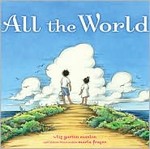
Books of Hope - All the World

Many of us live in the past or the future. We look back on good times that are now gone, or look forward to what might be coming. We forget to appreciate the amazing and wonderful things that are happening to us right now, and those amazing and wonderful things can be simple everyday moments. Seeing that a favorite flower is blooming, or sharing a smile with a complete stranger are the kinds of in-the-now moments that we need to savor.

Today's book of hope is all about celebrating the present, those times that enrich our lives in so many ways.

All the worldAll the world
Liz Garton Scanlon
Illustrator:  Marla Frazee
Picture Book
All ages
Simon and Schuster, 2009, 1416985808
Many of us spend our lives running from place to place, and from activity to activity. We rarely take the time to appreciate the now; to enjoy what we are doing right this minute. In this beautifully written and illustrated picture book, Liz Garton Scanlon and Marla Frazee have created a memorable text and lovely illustrations to tell the story of one day in the life of a family. As the day unfolds, we are reminded of the wonderful things that fill our lives, and the simple pleasures that make life so special.
   The book begins with two children playing on a beach. The build a sandcastle, dig a moat, and take “a shell to keep.” Then the family heads to a farmer’s market where they buy produce and flowers. There are moments that are trying, for example when a storm arrives and rain pours down, and there are moments when everything is right with the world.
   This book celebrates the connections between people, the wonders that fill our world, the high points that we share, and the low points that we also share. It is a title that readers of all ages will enjoy.

Books of Hope - Winnie the Pooh

When the world without gets dark and stormy, when illness strikes,  or when I am just worn down by life, I turn to a number of books for solace and comfort. One of the books I turn to is today's Book of Hope title. It may seem strange that I would consider Winnie the Pooh to be a book of hope, but I think it is just that. The Winnie the Pooh stories remind us of the simple joys, the little adventures, the funny situations, that make life rich and wonderful. Feeling rich in stories that are packed with humor and sweet affection most certainly gives the spirit a lift.

Winnie the PoohWinnie the Pooh
A. A. Milne
Illustrator:  Ernest H. Shepard
Fiction
For ages 5 and up
Penguin, 2005, 978-0142404676
Lets us hear a story. Christopher Robin has decided that the story he would like to hear should be one about his bear, "Winnie-ther-Pooh." Christopher thinks that Winnie would very much like to hear a story about himself, and so off we go, to the forest, where Winnie-the-Pooh lives.
   In the first story we are told, Pooh, who is very partial to food in general, and honey in particular, decides that he wants to climb a tree because there is a large bee hive at the top. Of course where there are bees there is honey, and where there is honey there are Poohs. At first Pooh tries climbing up the tree in the old fashioned way, but that turns out to be a painful exercise. So he heads off to find Christopher Robin, whom he hopes might have a solution to his problem. Sure enough, before long, Pooh is floating up next to the honey bee tree hanging from a large blue balloon. There still is a problem however, and the problem is that the bees, which are not unintelligent creatures, are beginning to get "suspicious."
   Poor Pooh. This is only the first of several rather uncomfortable adventures that he has. In the next tale we are told, the bear, who as I have said enjoys food, gets stuck in Rabbit's doorway. Pooh blames the size of the doorway, and Rabbit blames the size of Pooh. There is nothing to be done however, for Pooh is stuck tight. All Pooh can do is listen to a "Sustaining Book such as would help and comfort a Wedged Bear in Great Tightness" and wait to get thinner.
   A. A. Milne's deliciously funny stories about this lovable bear, with their wonderful use of language,  will never lose their charm. Pooh and his friends speak a language all children understand, and they make the kinds of mistakes that they understand too. At the same time, there can be no doubt that Pooh's tales delight adults as well. There is something about the bear's simple needs, his obvious devotion to his friends, and his delightful way of expressing himself that makes Pooh a panacea for a tired mind, an aching heart, or a weary spirit.
   Ernest Shepard's delightful illustrations perfectly capture the personalities of Pooh, Piglet, and their friends.

Friday, January 13, 2017

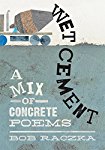
Poetry Friday with a review of Wet Cement: A mix of Concrete Poems

Concrete poems, or poems that are laid out on a page to create pictures, are such fun to explore; and to write. Poets who like to write such poems are wonderfully creative and they often inject their writings with a sense of fun as well. Today's title is full of these poems, and readers of all age will enjoy reading and looking at them.

Wet Cement: A mix of Concrete poems
Wet Cement: A Mix of Concrete PoemsBob Raczka
Poetry Book
For ages 7 to 10
Roaring Brook Press, 2016, 978-1-62672-236-1
For Bob Raczka, poems are “word paintings” because the words on the page “paint pictures inside your head.” The wonderful thing about concrete poems, or shape poems, is that the words also “paint pictures on the page.” The words are arranged in such a way that they create an image of something that represents what the poem is about. For example, for a poem about a candle, the words might we arranged on the page to look like a flame.
   In this collection of poems Bob Raczka has decided to take the picture-making aspect of his creations to another level. The words of the poems create a picture, and in addition the letters in the titles of the poems also create a picture.
   For example, in the poem Crossword, the letters in the title of the poem are arranged in such a way to create a cross. Then the words of the poem are placed on the page in such a way that they create what looks like a crossword.
   In the Poem Dominoes, the title letters are tipped to one side, and the words of the poem look like a row of dominoes that have also been tipped over. The text in the poem is written from the point of view of the dominoes themselves. They talk about the need to “brace yourself,” “forward march” and “do your part,” as they fall over and lean against each other.
  The poem Icicles is beautifully picture rich. Both the letters in the title and the words in the poem hang down like icicles from the eves of a building. The title is upside down and the lines of the poem hang sideways so that we have to turn the page to read them. They tell us how icicles form and how you can “Break one off and take a lick” when the icicles are “long and clear and ripe.”
   Children are going to be delighted when they see how the poems in this book loop and hop, circle, crisscross, and hang on the pages to create pictures. They may even be inspired to try creating concrete poems of their own.

Wednesday, January 11, 2017

Books of Hope - Miss Rumphius

This is one of my favorite picture books. The story reminds me that even the simple act of planting flowers can make the world a better place. What Miss Rumphius does is to give everyone who sees her flowers a gift of beauty, and imagine what that does for them. Maybe it makes them happy and lifts them up. Maybe it reminds them that the world is a beautiful place. Maybe seeing the flowers allows them to move forward with hope in their hearts.

Miss RumphiusMiss Rumphius
Barbara Cooney
Picture Book
For ages 5 and up
Penguin, 1985, 978-0140505399
When Alice was a small girl she used to talk to her grandfather about how, when she grew up, she would "go to faraway places," and when she grew old she would "live beside the sea." Alice's grandfather told her that in addition to these two things, there was a third thing that she must do, and that was to do something that would "make the world more beautiful."
   When Alice grew up to become Miss Rumphius she did indeed travel to far off lands, and she had all sorts of adventures. Then, when she began to get tired, she found a little house by the sea to live in. The question she now had was what she should do to make the world a more beautiful place.
   One day when she was out walking she found some beautiful lupines growing on a hillside. The lupines were the offspring of the flowers that she had planted in her own little garden the previous spring. Now Miss Rumphius knew what she would have to do. Back at home she sent away for bags and bags of lupine seeds and then she got to work sowing the seeds all over the countryside, making the hills and valleys around her home beautiful.
   This delightful story about dreams and the need to give something back to the world is both powerful and thought provoking. What the elderly Miss Rumphius does is not earth shaking, and yet it does make the world a more beautiful place, and her labours give lots of people great pleasure as they look at the fields of lupines that she sowed. The reader cannot help wondering what he or she can do to make the world a more beautiful place. Whatever one chooses to do, whether it is planting trees or joining a group to clean up the countryside, each effort to make the world more beautiful makes a difference.

Monday, January 9, 2017

Books of Hope, 2017: Reviews of books that empower, uplift, and give the reader hope.

Dear bookish friends:

2016 was a very strange year. It was a year during which we were subjected to so much discord and anger in the media and in our communities, and so much bad news. The year left many people, including myself, feeling shaken and worried for the future. I was thinking about this a week or so ago and trying to figure out what I could do to make my world a little brighter and more hopeful. Naturally my thoughts turned to books.

I have decided that I will review at least one book each week that offers up a message that is warming, thoughtful, and hopeful. I will choose books that remind us that the world is not always a terrible place. Perhaps the book will explore compassion. Perhaps it will tell the story of a person who has found a way to make the world a better place. Perhaps readers will see how differences can be overcome, and how bridges between conflicting groups can be built.

Though all of the books I review were written for young readers, I want you to know that the Books of Hope that I am going to share with you during this year will suit readers of all ages. Adults can get a lot out of reading children's literature, so don't be afraid to read one of these titles for yourself. See what you discover and learn. You may be surprised!

My hope is that these books will give you hope, and that that hope will help you to make our world a kinder, gentler, more compassionate place.


Picture Book Monday with a review of Gary

Twenty years ago I got a chronic illness that changed my life. I had to adjust my expectations, learn to live within my limits, and most importantly learn to enjoy and love the new life that I had built for myself. It was not easy. At all. It still isn't.

What I loved about today's picture book was the fact that it is about a character, Gary, who cannot do what his friends and relatives do, but he still manages to have a full life, one that offers him a unique perspective. In fact he is able to share what he learns with others, which is wonderful.

Gary
GaryLeila Rudge
Picture Book
For ages 5 to 7
Candlewick Press, 2016, 978-0-7636-8954-4
Most of the time Gary is just like the other racing pigeons that he lives with. He eats what they eat, lives in a loft, and dreams of going on adventures. However, when the other pigeons leave in the travel basket to attend races, Gary stays home and works on his scrapbook. Gary cannot fly, and so he cannot join the other racing pigeons on race days. Instead, he lives vicariously through his friends, recording their race experiences in his scrapbook.
   One night Gary leans over from his perch so far that he loses his balance. Gary and his scrapbook fall into the travel basket, and the next day he, still in the basket, is taken far from home. When he arrives at his destination the basket is opened and the sky is “full of feathers and flapping wings.” The racing pigeons are off, but Gary, who cannot fly back home like the other pigeons, is stuck, lost in a city that he does not know at all.
   Needing cheering up, Gary looks at his scrapbook, and little by little the cityscape around him starts to look “a little more familiar.”
   This wonderful picture book tells the story of a bird who cannot fly and who therefore cannot see the world. Except through the pages of his scrapbook. Then life presents Gary with a situation that could turn out to be a disaster and he has to figure out a solution.
   What is perhaps the best part of this delightful story is the way in which it ends. It turns out that Gary, the pigeon who cannot fly, has something to offer the pigeons who can fly.


Friday, January 6, 2017

Poetry Friday with a review of Before Morning

I know that children are the ones who are supposed to hope and wish for a snow day, but I have to confess that I hope and wish for them too. There is nothing like taking a day off work to play in the snow with dogs and family members; and to sit toasting toes in front of the fire afterwards. In today's poetry book  we meet a little girl who desperately wants a snow day, and her reason for wanting such a day is even more important that having a day off from school.

Before MorningBefore Morning
Joyce Sidman
Illustrated by Beth Krommes
Poetry Picture Book
For ages 5 to 7
Houghton Mifflin Harcourt, 2016, 978-0-547-97917-5
A little girl and her mother arrive home on a cold winter night. Dinner is on the table and all should be well, but the little girl is sad. Soon her mother is going to be leaving for the airport where her plane and crew await her. She is a pilot and her job means that she has to leave home for days at a time.
   The little girl hides her mother’s pilot hat, but has to give it back. Her mother has to go to work and there is nothing that can be done about it. While the little girl sleeps “In the deep woolen dark” that is now freckled with snowflakes, the pilot packs her bags and leaves the house. What the mother does not know is that her daughter has sent a wish up into the night, a wish asking for the snow to come and “Let the air turn to feathers, / the earth turn to sugar.” The little girl wants everything to be “swaddled” in a blanket of snow.
  The hope is that the snow will be heavy enough that “urgent plans founder,” and planes will be grounded so that her mother will be able to come home to her.
   With gorgeous scratchboard art what is rich in textures, and a magical rhyming text that is beautiful in its minimalism, this unique picture book celebrates the power of a child’s wish.

Monday, January 2, 2017

Picture Book Monday with a review of First Snow

There is something wonderful about waking up in the early hours of the morning to discover that snow has fallen in the night. Everything is quiet, muffled by the snowfall, and there is a feeling of excitement that is intoxicating to the spirit. In today's picture book a little child ventures out into the night after the first snowfall and she has a magical adventure in the woods.

First SnowFirst Snow
Bomi Park
Picture Book
For ages 4 to 6
Chronicle Books, 2016, 978-1-4521-5472-5
It is nighttime and a little child, snuggled up in bed with her teddy bear, hears a noise. Something is gently tapping on her bedroom window. She crawls out from under the covers to take a look and sees that it is snowing. Quickly she puts on her snow clothes and goes outside. One of the puppies is awake too and it leaves the warmth of the dog house to see the little girl. It watches as the little girl creates a ball of snow and then it follows as she rolls it across the ground, out of the garden, past the houses, and “Beneath the lights.”
   Across the fields the companions go, along the railroad tracks, and into the woods, where animals watch their progress. The little girl’s ball of snow is quite big now and rolling it along is hard work. Then, there in the dark woods, the little girl sees a glowing gateway to somewhere else, and through it she goes rolling her ball of snow.
   In this wonderful book a simple nocturnal adventure unfolds to become something altogether bigger; something magical happens and we are transported to a wonderful place to celebrate the joy of a first snowfall. 

Friday, December 30, 2016

Poetry Friday with a review of Switching on the Moon: A very first book of Bedtime Poems

When my daughter was little she and I used to sing a little lullaby every night. The overhead light would be out, the unicorn nightlight would be glowing, and for those few precious moments she and I would sing the comforting rhyming lines. There is nothing quite like sharing poetry (sung or spoken) with a child last thing at night, and today I have a book for you that is packed with poems that are perfect for bedtime.

Switching on the Moon: A Very First Book of Bedtime PoemsSwitching on the Moon: A very first book of Bedtime Poems
Collected by Jane Yolen and Andrew Fusek Peters
Illustrated by G. Brian Karas
Poetry Picture Book
For ages 3 to 5
Candlewick Press, 2010, 978-0-7636-4249-5
For many children around the world bedtime is synonymous with little songs and poems. The soft lilting cadence of rhymes is so well suited to helping children to settle down and prepare for sleep, and they also help children to connect with the grownups who share these songs and poems with them.
   In this wonderful book a variety of poems about bedtime are brought together so that children can enjoy the gift of beautiful language just before they go to sleep. The poems are divided into three sections. There are verses that describe those pre-bedtime moments, lullabies, and finally there are poems that capture nighttime sounds, moments, and experiences.
   The poems found in the collection are all very different, but one thing they all have in common is how soothing they are. Musings, words of love and comfort, and descriptions - all written by poets from around the world - offer children and their grownups a delightful journey into the world of beautiful language.
   Some of the poems found on these pages may be familiar, like Rock-a-bye Baby and The Man in the Moon. Many others will be new to readers, who will enjoy exploring the writings of Langston Hughes, Jane Yolen, Lee Bennett Hopkins, Lord Tennyson, Sylvia Plath, Marilyn Singer, and others.
   Throughout this wonderful volume, beautiful artwork accompanies the poems and makes this book a work of art that would make a wonderful gift for a family who has a new baby to love care for.

Monday, December 26, 2016

Picture Book Monday with a review of A Warm Winter

I love seasonal picture books, because I love the way they connect us with what is going on outside at this particular moment. They connect us to a rhythm that is bigger than the one that many of humans seem to follow. Today's picture book takes us into a snowy, wintry landscape that is beautiful and stark. On the pages we meet a determined little mouse who is trying to collect firewood so that he can keep his family warm.

A Warm WinterA warm winter
Feridun Oral
Picture Book
For ages 4 to 6
Minedition, 2015, 978-988-8341-29-0
One cold winter’s day Little Mouse leaves the comfort of his nest to go out into the snow to find some firewood. Trailing his red scarf, which is very long indeed for such a small animal, Little Mouse finds twigs, pinecones and sticks until he has a huge pile.
   Little Mouse ties up the pile with his scarf, rests a little and then he tries to pull his load across the snow. There is no way the pile is going to budge. Little Mouse is just too small to pull so much weight.
   Little Mouse asks his friend Rabbit for her help. Even when they “join forces” they cannot move the massive pile of firewood. The animals then ask Fox if they can borrow his sled, which he is quite happy to lend them. The firewood is piled on the sled and they all start pulling, but “the pile simply would not budge.”
   There is only one thing left to do; the animals are going to have to wake up Bear to ask for his help. The weather is getting bad and if they don’t get indoors soon everything will soon be buried.
   Bear, being a good fellow, is happy to help his friends, even though they woke him up. Together the four animals pull and pull until something very unexpected happens.
   This wonderful snowy picture book celebrates friendship, and shows to great effect how wonderful it is when people (or animals) work together to help one another.

Friday, December 23, 2016

Holiday Greetings


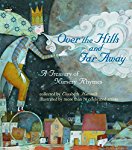
Poetry Friday with a review of Over the Hills and Far Away: A treasury of Nursery Rhymes

Like many children I got to experience nursery rhymes when I was little, often when I was sitting in someones lap. I was lucky because I was bilingual, and so I was given the gift of rhymes that were written in English and in French. In English many of the rhymes were from Mother Goose collections. The French books contained French nursery rhymes that many English speakers do not normally get to read. What I love about today's poetry book is that the editor has brought together nursery rhymes from all over the world. She thus allows us to experience rhymes that we have probably never heard before.

Over the Hills and Far Away: A Treasury of Nursery RhymesOver the Hills and Far Away: A treasury of Nursery Rhymes
Collected by Elizabeth Hammill
Illustrated by more than 70 celebrated artists
Poetry Picture Book
For ages 4 to 6
Candlewick Press, 2014, 978-0-7636-7729-9
Many people living in Britain or the United States have grown up with a copy of Mother Goose’s rhymes on their bookshelf. The interesting thing is that often the rhymes one finds in these two countries are different in some ways, and yet the feel of the rhymes is the same. When you then look in other countries where English is spoken, you find other versions of Mother Goose rhymes that have taken on the flavors of the cultures in those countries.
   In addition to these Mother Goose verses, there are nursery rhymes that are unique to the countries where they were written and that capture the essence of the history and traditions in those countries
   In this collection Elizabeth Hammill brings together Mother Goose rhymes from around the world and presents them alongside rhymes that are African, Asian, Caribbean, Native-American, and Hispanic to give readers a truly diverse and rich nursery rhyme experience.
   Throughout the book the poems are paired with artwork that was created by seventy-seven artists from the English-speaking world. Some of the artists have been working in their chosen field for a long time, while others are newcomers to the illustration stage. All of the artwork was donated to this book project by the artists to support Seven Stories, Britain’s National Centre for Children’s Books.
   Our nursery rhyme journey begins with a short Native American verse which is then followed by an African nursery rhyme that captures a mother’s love for her baby. There are other mothers, the mother in the poem says, who would “like to have you for her child,” but they cannot have the baby because the precious child is “mine.” Many of the poems that follow celebrate a mother’s love for her child or baby, while others are nonsense poems, counting poems, poems about animals, poems about places, and poems that tell a story.
   This is a wonderful book to share with children, but it is also the kind of book that offers adults the opportunity to explore the world of nursery rhymes both historically and geographically. Readers are able to see how different cultures use words to comfort, amuse, and delight their children.


Monday, December 19, 2016

Picture Book Monday with a review of The Christmas Eve Tree

Christmas is less than a week away, and people all over the world are putting up and decorating their Christmas trees. There is something magical about seeing a tree, decorated with tinsel and ornaments, its lights shining in the darkness. Today's picture book is about a Christmas tree that ends up lightning up Christmas for those who need the light the most.

The Christmas Eve TreeThe Christmas Eve Tree
Delia Huddy
Illustrated by Emily Sutton
Picture Book
For ages 5 to 7
Candlewick Press, 2015, 978-0-7636-7917-0
Years ago a grove of Christmas trees was planted. One of the little fir trees was blown sideways into its neighbor by the wind and did not grow properly. When the trees were harvested the little fir tree, which was “stunted” and “tangled with its neighbor” was taken to the big city. The other trees were bought and placed in a cathedral, in the middle of a square, on the stage “at a grand Christmas ball,” and in private homes where children and their families decorated them for the festive season. The little fir tree and its bigger partner ended up in a store. On Christmas Eve the big tree was bought and taken away and the little fir tree was now all alone.
   A poor boy came into the shop to warm up and he asked a store clerk, who was about to throw away the little tree, if he could have it. The clerk “handed it over,” and some time later the boy, with the tree ‘planted’ in a cardboard box full of beach mud, was sitting under the arch of a railway bridge, in the large cardboard box that served as his home. With a coin that a passerby dropped in his hat the boy bought some candles and matches and he decorated the little tree with the candles, creating a little pool of Christmas spirit in a rather bleak place.
   The boy was joined by other homeless people and a tree performer and soon they were all sharing Christmas songs, which drew more and more people to the little tree. Though the tree’s surroundings were very humble, it felt as if it would “burst with happiness” because for a while the hard circumstances of the boy’s life did not matter. For a while the tree gave the boy and many other people joy.
   In this beautiful picture book readers will find a story that is sure to become a firm favorite with readers of all ages. This is the kind of book that families will keep on their shelf and bring out every holiday season to share and enjoy.

Friday, December 16, 2016

Poetry Friday with a review of Love that dog

When I first saw this book on a shelf in the library I thought it was going to be about a dog, which is a natural assumption to make I think. A dog does play a role in the narrative, but the story is really about a boy's relationship with (and discovery of) poetry. It is a fabulous book, a powerful book, a sometimes funny book, and I think readers of all ages will appreciate it.

Love That DogLove that Dog
Sharon Creech
Poetry
For ages 8 to 12
HarperCollins, 2001, 978-0060292874
Jack is in Miss Stretchberry’s class and he is not happy because she is expecting her students to write a poem. Everyone knows that girls write poems. It is a girly kind of thing to do. After claiming that his “Brain’s empty,” Jack finally condescends to write a poem about a blue car speeding down a road. He is rather put out when his teacher comments on how something is missing in his poem. If Robert Frost can leave his poems incomplete why can’t he?
   Miss Stretchberry then asks Jack to write a poem about a pet. Jack does not have a pet anymore and he does not want to write about the dog that he had. We can sense that doing so will be painful for Jack, and yet the boy does end up writing a description of how the yellow dog became a member of his family; how they got him from the animal shelter and saved him from being euthanized, which is what happens to the shelter dogs that are not adopted. Miss Stretchberry asks Jack if she can type up his poem about the yellow dog and share it with the class. He decides that she can if she wants to, though she cannot put her name on the piece.
   Next Miss Stretchberry introduces Jack and his classmates to concrete poems and these he likes a lot. In fact he even tries to create one called My Yellow Dog, and he arranges the words so that they look like a picture of dog on the page. Miss Stretchberry asks if she can type up his poem again and this time Jack is willing to let her put his name on it, which is a new development.
   Inspired by a poem that he loves that was written by Walter Dean Myers, Jack writes another poem about his dog Sky, and in it he captures the joy the dog brings into his life. It is a poem from the heart and Jack cannot help feeling pleased when his teacher shares it with the class again.
   When Miss Stretchberry suggests that Jack should write to Walter Dean Myers, Jack is appalled. Why would a famous writer like hearing from a kid? Surely he would prefer to hear from a teacher “who uses big words / and knows how / to spell / and / to type.” In the end Jack writes the letter, with many apologies to Walter Dean Myers for taking up his time. Jack even invites the writer to come to his school.
   As he waits to hear from Walter Dean Myers, Jack’s journey into the world of poetry progresses. He starts learning how to type and finally he writes (and then types up) a poem about what happened to Sky, though he is not sure about putting his name on it.
   This remarkable book takes us through a school year with a boy called Jack. As the months go by we see how this boy, who wants nothing to do with poetry at first, starts to appreciate the way words in poems can capture moments and feelings in a fresh and different way. Slowly, like a flower opening, he tries writing his own poems. By the time we leave Jack, with his memories of Sky, he is a very different child, and we, as witnesses to his journey of exploration, can celebrate the changes that have taken place in him. 

Monday, December 12, 2016

Picture Book Monday with a review of The Wish Tree

This is the time of year when children all over the world hold their wishes close, hoping that Santa, Father Christmas, or St. Nicholas will be able to read the wishes in their hearts and make them a reality. In today's picture book you will meet a little boy who wants more than anything to find a wish tree, which he is convinced is a real thing. Rather than waiting for someone to find such a tree for him, the little boy sets out to find the wish tree himself, and in the process he makes a lot of wishes come true for others.

The Wish TreeThe Wish Tree
Kyo Maclear
Illustrated by Chris Turnham
Picture Book
For ages 5 to 7
Chronicle, 2016, 978-1-4521-5065-9
One day Charles decides that he wants to find a wish tree. His older sister and brother say that “There is no such thing” as a wish tree, but Charles, and his friend Boggan, are convinced otherwise and so the next morning the boy and his toboggan set off.
   Together the friends climb a hill and sledded down to a “frost meadow” on the other side. Though they do not find a wish tree they do find a squirrel who needs help getting his haul of hazelnuts back to his home in a tree. Boggan and Charles are happy to help out.
   Later the friends help a beaver get a load of birch wood back to his lodge, and help a fox get some berries back to her burrow. Again and again Charles and Boggan assist the woodland animals who need help getting food and other materials back to their homes.
   The day begins to wind down and poor Charles and Boggan are no closer to finding a wish tree. They have seen so much during the day, except the one thing that they are looking for. Charles is so tired that he decides that he cannot search any longer. In fact he falls asleep on Boggan, which is when something magical happens.
   This wonderful wintery picture book will appeal to readers of all ages and backgrounds. Though it is certainly about a little boy’s quest, it is also about friendships that bloom during that quest. With delight we see how gifts are returned to someone who gives of himself so easily and freely. 

Friday, December 9, 2016

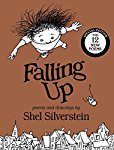
Poetry Friday with a review of Falling Up

I usually offer up a preamble before I jump into my reviews, but today's poetry title needs no introduction because Shel Silverstein needs no introduction. What is special about this particular edition is that it contains twelve new poems!

Falling Up SpecialFalling Up
Shel Silverstein
Poetry
For ages 6 to 8
HarperCollins, 2015, 978-0-06-232133-6
Poets have been writing nonsense and funny poems for children for many years, and have given their readers amusing characters and wonderful stories in verse to read over and over. A.A. Milne, Edward Lear, and many others have delighted young readers with their comical writings, but it has to be said that one of the most famous and well-loved humorous poets is Shel Silverstein. He left behind him a wonderful collection of poems for young readers, poems that children and their grownups have been enjoying ever since they came out in print.
   On the pages of this book young readers will meet a colorful collection of characters who often have very bizarre adventures. For example, there is a little boy who, when he tripped over a shoelace, fell up instead of down. He floated up into the sky and the experience would surely have been amazing except for the fact that he got so dizzy and sick to his stomach that he “threw down.”
   Then there are poems that capture moments in a child’s life that are very familiar. In Diving Board we meet a boy who has made sure that the diving board is “nice and straight” and that is can “stand the weight.” He has verified that it “bounces right,” and that his toes “can get a grip.” The only thing left to do is to dive, but we cannot help thinking that perhaps that is the one thing he won’t do.
   Writer Waiting captures another familiar situation to perfection. A child sits in front of a computer, a wonderful device that can do so many things that a writer does not need a “writing tutor.” The computer can spell and punctuate, “edit and select,” “copy and correct.” The one thing that it cannot do is figure out what you should write about.
   The cartoon style illustrations that accompany the poems in this book often add a great deal to the writing, and in some cases they provide a visual punchline that readers will thoroughly enjoy.
   This wonderful special edition volume includes twelve poems that were not included in the original 1996 copy of this title. The author’s family very kindly agreed to share these poems and their accompanying drawings with readers, and what a gift they have given us.

Monday, December 5, 2016

Picture Book Monday with a review of Sleep Tight Farm

This morning I woke up to find that it had snowed in the night. The trees and shrubs in our garden, and the grape vines in the vineyard looked as if they had been tucked up under a cozy, fluffy eiderdown. I was grateful that I had managed to get everything ready for the colder months in time, though the baby olive trees in their pots still need to be put under cover so that they don't freeze.

Getting a farm ready for the winter is not an easy task, and in today's picture book you will get to spend some time with a family who spend many busy days putting their farm to bed for the cold season.


Sleep Tight Farm: A Farm Prepares for WinterSleep tight farm: A farm prepares for winter
Eugenie Doyle
Illustrated by Becca Stadtlander
Picture Book
For ages 5 to 7
Chronicle Books, 2016, 978-1-4521-2901-3
It is December and the days are getting shorter and darker. The big hay and corn fields are empty, the trees are bare, and all is quiet, but at the farm the people are busy; it is time to put the farm “to bed” for the winter.
   Out into the cold morning they go to cover the strawberry plants with hay so that they will be protected from “winter’s frosty bite.”  Raspberry plants are also prepared for the winter, their canes cut back so they cannot be cracked by wind and snow.
   The last of the fall vegetable crops, kale, carrots, beets and potatoes, are harvested and stored in the barn. The hay was brought in weeks ago and now Dad goes out into the field to plant a cover crop so that the fields are replenished before the next season.
   Wood is chopped so that the house will be kept warm through the winter months, and the chicken coop and bee hives are winterized so that the chickens and bees will be warm and safe. This is much to do before the farm and it people can take a well-earned rest.
   In this wonderful picture book we see how the members of a family work together to get their farm ready for winter. There is a lot of work to be done, and at the same time there is a lot of gratitude to offer up for all that the farm has given the family in the spring, summer, and fall. The farm has been good to them and they have not forgotten this.


Friday, December 2, 2016

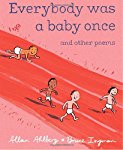
Poetry Friday with a review of Everybody was a baby once

Anyone who has watched a young child listening to someone reading a nursery rhyme to them knows that young children have a natural appreciation for rhymes and verse. Their minds are open to the wonderful possibilities that are inherent in poetry. Today's poetry title was written especially for young children, and it offers them the gift of humor and wonderful language.

Everybody Was a Baby Once: and Other PoemsEverybody was a baby once and other poems
Allan Ahlberg
Illustrated by Bruce Ingman
Poetry Book
For ages 2 to 4
Candlewick Press, 2010, 978-0-7636-4682-0
Poetry can enrich the lives of readers of all ages, but all too often older children and adults are reluctant to explore the world of poetry because they think that poetry is not for them. Thankfully, young children are more open to receiving the gift of poetry. Indeed, they often embrace the world of poems and have a natural affinity for them.
   In this splendid book young children will encounter a collection of poems that will beautifully resonate with their interests, their sense of humor, and their love of stories. For example, in When I was a Little Child they will ‘meet’ a child who tells them what life was like when he was young. When you are small the world you interact with is very different because of your size and because so much of what you see and experience is new and exciting. A bath is “like the sea” and a high chair is a “mighty tower.” Stairs seem to go to “mountaintops” and a father is “like a tree.”
   As they explore this book children will encounter some poems that provide them with information. They learn what to do if they meet a witch, and what monsters like to eat. For example at breakfast time monsters munch on “Tadpole toasties” and “Dreaded wheat,” and for dinner they have “moldy greens” and “Human beans.” Knowing such important facts about monsters is vital for one’s education after all.
   There are also story poems of all kinds that will surely amuse little children and their grownups. Who can resist a story about how snowmen used to be “In the good old days / When snow was snow,” and the one about a soccer match that took place between two teams of animals, with elephants on one side and insects on the other. One can only imagine how such a game would turn out.
   This is a wonderful book to share with young children. It not only introduces children to the magic of poetry, but it gives adults the opportunity to share some precious, bookish, time with the child or children in their lives. 

Monday, November 28, 2016

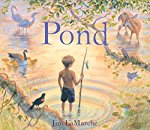
Picture Book Monday with a review of Pond

Children often feel very overwhelmed when they see all the problems in their world. Stories about wars, environmental disasters, famines, political conflicts, and social upheavals fill newspapers, news broadcasts, and social media. There is so much wrong out there that they often think that there is nothing that they can do that will have an impact on so much chaos. The truth of the matter is that every little effort that makes the world safer, kinder, and cleaner is a step in the right direction.

Today's picture book shows how some children bring about change for the better in their own little world, and that change, though its impact is not global, is still vital and precious.


PondPond
Jim La Marche
Picture Book
For ages 5 to 7
Simon and Schuster, 2016, 978-1-4814-4735-5
One cold winter day Matt is out walking when he comes to a place that he and his friends call “the Pit.” It is usually just an open space in the woods that is full of trash, but on this day he sees that a stream of water is bubbling its way out of the ground. Matt looks around and realizes that this neglected place was once a pond and he makes a decision. He is going to bring the pond back.
   Matt tells his sister Katie and his best friend Pablo about his discovery, and asks them if they are willing to help him clean the place up. Both agree and the very next weekend the three young people get to work. They pick up all the junk and trash and, with Pablo’s father’s help, take it all to the dump. Then they move rocks to create a dam.
   As the days go by and winter softens into spring, the pond starts to fill up. In the summer the children spend time by the water until they are driven off my biting insects and summer storms. Then Matt’s dad decides to help the children work on an old row boat so that it is seaworthy once again. Together they work at patching holes, sanding rough wood, and nailing down boards. The boat is named Dragonfly, and when the children take it out on the water it floats.
   As the months go by the pond offers Matt and his friends and family members all kinds of seasonal joys, and it also gives animals a place to call home.
   This wonderful book takes us through the seasons with a boy who, thanks to his imagination and hard work, is able to bring back a gift of nature that was lost. A neighborhood pond might seem like a small thing, but the special moments it gives Matt and his friends are precious. As they watch the pond grow and flourish, the children in the story grow to appreciate that sometimes the little things can become big things.
   Children who think that they are too small or too young to make a difference in the world will surely be empowered by this tale. They will see that they, like Matt, can bring about change for the better if they really want to.

Monday, November 21, 2016

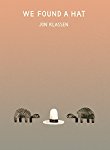
Picture Book Monday with a review of We found a hat

Learning to be unselfish is one of life's hardest lessons. For most of us remembering to think of others before ourselves is a daily battle, one that we sometimes lose. We know what we are supposed to do. We know that we are supposed to share with others and sometimes give up things we want for their sake, but doing so is just so hard.
   In this wonderful picture book we see what happens when a pair of friends find something that they both want. How will they resolve a tricky situation? Will they put friendship first?

We Found a HatWe found a hat
Jon Klassen
Picture Book
For ages 4 to 7
Candlewick Press, 2016, 978-0-7636-5600-3
One day two turtles are walking in a desert together and they find a wonderful hat, a tall, elegant Stetson. They both try the hat on and compliment each other on how “good” the hat looks. The hat “looks good on both of us,” they say but the problem is that there is only one hat and it would not be fair if one of the turtles had the hat and the other did not. There is only one thing to do. They are going to have to leave the hat where it is and “forget that we found it.”
   The two turtles walk to a nearby rock and settle down to watch the sunset. One of the turtles says that he is thinking about the sunset, the other says that he is thinking about nothing but we know that he is thinking about the hat, and looking back to where it lies on the ground. The pull of the hat is strong and the turtle is having a hard time staying true to his friend.
   Life is full of difficult choices and often the most hard-to-make ones are those that require that we make a sacrifice. In this wonderful picture book we meet a turtle who really wants something and he is forced to consider if the hat is worth more than the relationship that he shares with his best friend. Thankfully there is someone around who sets an example for him that helps him understand what true friendship is worth.

Friday, November 18, 2016

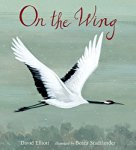
Poetry Friday with a review of One the Wing

I live on a ten acre farm on a hillside, and we get lots of bird visitors. Owls live in one of our outbuildings, and swallows spend the summer in our barn. We have seen bald eagles sitting in our trees, and red-tailed hawks often swoop over the house calling out to each other. I cannot help being charmed by the birds that I see and so I really enjoyed today's poetry book, and I hope many of you will enjoy reading it too.

On the WingOn the wing
David Elliott
Illustrated by Becca Stadtlander
Poetry Picture Book
For ages 6 to 8
Candlewick Press, 2014, 978-0-7636-5324-8
Animals have inspired musicians, artists, prose writers, and poets for centuries. T.S Elliot, who loved cats, was drawn to creating poems about felines. Others have captured the majesty of a tiger, the gravitas of elephants, and the watchful nature of rabbits. Birds, perhaps more than any other animal - other than cats and dogs - have attracted the attention of poets. Perhaps this is because birds are found everywhere, in all kinds of environments. They are also often beautiful and come in so many shapes, colors, and sizes.
   In this excellent poetry title we encounter a wonderful collection of birds from tiny gem like hummingbirds that  are “Always / in a / tizzy” going back and forth and zooming to and fro busily, to the giant Andean Condor that could, if we are not careful “disappear,” taking with it the memories of ancient times that we humans are losing.
   Some of the birds we meet on the pages will be familiar. We see them in parks, on windowsills, and in gardens. These include sparrows, blue jays, cardinals, crows, and owls. Others are like the exotic Caribbean Flamingo who’s bright pink plumage seems to set the sky “alight” when they take to the air.
   This would be a wonderful book to share with children who have an interest in birds. Throughout the book the combination of wonderful poems and lush paintings gives children a special bird-filled experience.

Monday, November 14, 2016

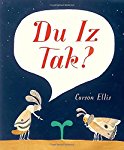
Picture Book Monday with a review of Du Iz Tak?

Many people are convinced that the best stories are ones that are packed with a huge cast of characters, a constantly changing backdrop, a busy back story, and a great deal of drama. To be sure such stories are gratifying and engaging, but smaller, quieter tales can be incredibly rich and rewarding as well. Today's picture book story is just such a tale. The characters are insects, the setting never changes, and the events that unfold are not packed with grandiose spectacles. Instead, we are given a gem of a story that takes us into a small world where powerful and meaningful things happen on a small scale.

Du Iz Tak?Du Iz Tak?
Carson Ellis
Picture Book
For ages 5 and up
Candlewick Press, 2016, 978-0-7636-6530-2
One day two elegant insects see that a green plant is growing out of the ground and they wonder what it is. A while later three young beetles turn up and the green thing has grown. They too would like to know what the plant is. The beetles climb to the first layer of leaves and they want to go higher to the second set but they cannot reach. They decide to go and ask Icky the caterpillar if they can borrow a ladder. The kindly fellow goes and gets his very long ladder and he props it up against the plant.
  With the ladder in place, the three beetles can now climb as high as they like, and when they get up into the higher branches of the plant– which is quite a way up now because the plant is still growing - they decide to build a tree house. Actually they build three tree houses at different levels, and life is wonderful. Then a huge spider builds a web around the houses and the plant, and the beetles can do nothing about the invader who has taken over their home.
   In this wonderful picture book, several backyard stories featuring insect characters unfold before our eyes. The insects speak their own language, which is not surprising when you think about it, but luckily we can figure out much of what they are saying and we have no trouble understanding what is going on. What is delightful about this story is that though the main characters are insects, and though the setting in the book is the same one throughout the tale, the story we witness is rich, charming, and satisfying.

Friday, November 11, 2016

Poetry Friday with a review of The death of the hat: A Brief history of poetry in 50 objects

One of the wonderful things about reading books that were written at different moments in time is they tend to reflect the culture and conventions of the era in which they were written. Stories and poems can give us a glimpse into the past and help us to get a picture of what life was like then.

In today's poetry title readers will find poems that were written long ago and not so long ago, and in each one the poet describes an object of some kind. Children and adults alike are going to enjoy exploring this book.

The Death of the Hat: A Brief History of Poetry in 50 ObjectsThe death of the hat: A Brief history of poetry in 50 objects
Selected by Paul B. Janeczko
Illustrated by Chris Raschka
Poetry Picture Book
For ages 8 to 12
Candlewick Press, 2015, 978-0-7636-6963-8
For almost as long as humans have been writing, humans have been creating poetry. Throughout history men and women all over the world have been using poetry as a means to tell a story, describe something, capture a moment in time, or expound on an idea or feeling that interests them. Like music, art, and prose writing, poetry has evolved over the ages and when we look at poems from different eras we can see the trends, conventions, and fashions that were popular at that time.
   In this very unique poetry collection Paul Janeczko explores how poets, over the ages, have described objects in their writings. The poems capture the flavor of the times in which they were written, thus making it possible for readers to get a sense of how styles and ways of expression changed over time.
   We begin in the early Middle Ages with a poem about a bookworm. The poem describes how a moth ate a word. The poet feels that it is curious that such an insect could “swallow the word of a man.” Like a “thief in the dark” it takes something profound and is not “A whit the wiser” afterwards.
   The Renaissance brings us the words of William Shakespeare and we are given a speech from Romeo and Juliet. The excerpt is Mercutio’s speech about Queen Mab, who is a tiny fairy. In a chariot made of an empty hazelnut she travels across the faces of men while they sleep. Shakespeare’s contemporary, Ben Jonson, offer us a poem about the sun, and we read about how the sun breaks free of the bonds of winter, melting the ice on streams, and encouraging trees to dress their nakedness with “crisped heads.”
   In the romantic period we find poems by Lord Byron, William Wordsworth, Lord Tennyson, and Henry Wadsworth Longfellow. Here there are poems about the letter E, a mouse’s nest, an eagle, and snow-flakes.
   The Victorian era brings us poems by Edgar Allen Poe, Walt Whitman and Emily Dickenson, among others. We can see how these writings were influenced by the creations of earlier centuries and then we can see how the writers of the modern period (from 1900 to 1945) took a very different path. Poets tried new forms and experimented with words. This experimentation, and the innovative path that went with it, has continued to the present day.
   What is interesting about this book is that it can be enjoyed on many levels. Readers can simply enjoy the poems, dipping into the book at random, or they can explore the historical aspect of the collection.
   An introduction at the beginning of the book provides readers with further information about the time periods that are mentioned in the text.


Monday, November 7, 2016

Picture Book Monday with a review of Penguin Problems

Like it or not, we all are, on occasion, prone to being a little self-centered. When the world does not give us what we want we whine and wail about how terrible our life is and how the system is out to get us. In today's book you will meet a penguin who is convinced that every aspect of his life is a disaster, a nightmare. And then someone comes along who helps him gain a little perspective.

This is a deliciously funny book, and it is also one that gives is a gentle, thoughtful reminder that we should take the time to look around so that we see what we are perhaps missing.

Penguin ProblemsPenguin Problems
Jory John
Illustrated by Lane Smith
Picture Book
For ages 5 and up
Random House, 2016, 978-0-553-51337-0
One morning Penguin wakes up “way too early” and immediately he starts to complain. His beak is cold, the other penguins are making too much noise, and it snowed again the night before and he does not really like snow. Or the sun, which is too bright.
   Feeling hungry, Penguin heads to the ocean. He finds the water too salty and he does not think he floats enough. In short he sinks “like a dumb rock.” When he dives under water to look for fish he encounters a hungry orca, and a hungry seal, and a hungry shark.
   Though he is still hungry himself, Penguin gets out of the water because his flippers are tired from all the hard swimming he has had to do to avoid being eaten. It is hard work swimming when you are a penguin. It’s also hard work walking, or rather waddling, on land. If only Penguin could fly, but he can’t. If only Penguin could figure out which of the many penguins around him is his mother or father but he can’t because all the penguins look alike. If only….
   Then a walrus comes over to a now thoroughly upset Penguin and offers him a few sage words of advice.
   It is all too easy to get disgruntled about one’s life, to spend one’s days complaining about all the things that are not perfect, and to feel much put upon by one’s circumstances. However, behaving in this manner does not really make anything better. In fact, griping and grumbling more often than not just makes us feel worse.
   In this clever picture book we meet a very disgruntled penguin who is so busy being upset with his lot in life that he forgets to notice that there are many wonderful things around him, things that should be giving him joy. If only he would bother to notice them.

Friday, November 4, 2016

Poetry Friday with a review of Presidential Misadventures:Poems That Poke Fun at the Man in Charge

After months of media coverage and a great deal of discord, the lead up to Election Day is finally almost over. The end is almost in sight. I thought that I would offer my readers a little light relief on this poetry Friday. Today's poetry book looks at the lives of all the men who have been the president of the United States, from George Washington to Barack Obama.Using short and always amusing poems, the author makes fun of the Commanders in Chief in a creative way that readers of all ages will appreciate.

Presidential Misadventures: Poems That Poke Fun at the Man in ChargePresidential Misadventures: Poems that make fun of the man in charge
Bob Raczka
Illustrated by Dan E. Burr
Poetry
For ages 8 to 12
Roaring Brook Press, 2015, 978-1-59643-980-1
In 1890 a bored school boy called Edmund Clerihew Bentley was in science class listening to his teacher talk about Sir Humphry Davy, who was a famous English scientist. While the teacher talked, Edmund wrote a four lined poem about Sir Humphry, one that made fun of him. The form that Edmund used ended up becoming popular and today these poems that poke fun at famous people are known as clerihew poems.
   The rules for writing such poems are simple. They have to be four lines long and the first two lines have to rhyme, as do the last two lines. The first line should contain the name of the person who is being made fun of, and the meter in the poem should be irregular.
   Delighting in this poetry form Bob Raczka decided to write a whole book of clerihew poems which feature the presidents of the United States. Many of the poems that appear in this collection contain true facts about the presidents who have served the American people over the centuries. For example, the poem about William H. Taft tells us that the president, because of his rather large size, got stuck in the tub. This, is fact, really did happen. Similarly Richard Nixon did indeed tell “a lie he couldn’t fix,” and Ronald Reagan did have a fondness for jelly-beans.
   The author gives us poems for every single president, from George Washington to Barak Obama, and in each one clever touches of humor and word use offer future potential clerihew poets much to think about.

Monday, October 31, 2016

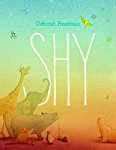
Picture Book Monday with a review of Shy

For many of us, talking to people we do not know is a very hard thing to do. Even when we really want to make friends, taking that step to connect with someone new seems almost insurmountable, especially if it takes us out of comfort zone and forces us to go somewhere that we are not familiar with.

Today's picture book beautifully captures the journey that a character takes when he has to leave the place he knows, to seek out something that he desperately needs.

ShyShy
Deborah Freedman
Picture Book
For ages
Penguin Random House, 2016, 978-0-451-47496-4
Shy is happiest when he is “between the pages of a book,” when he can go to “a land far away” and experience “once upon a time.” Shy particularly loves books about birds, where he happily reads about their beauty and their songs. The sad thing is that Shy has never heard real bird song because the birds in books cannot sing.
   Then one day a little yellow bird flies by, a real bird that sings. Shy is delighted, and overwhelmed. He would love to talk to the bird but has no idea how to do so. What if he makes a mess of things, what if he makes a fool of himself, what if…
   And then the bird is gone.
   Shy so wants to follow the bird, but he has never left his safe little hiding place within the pages of books. He has never ventured out into the world. Though he is afraid, Shy leaves his home for the first time in his life and what he sees as he seeks out the bird amazes him. There are all kinds of animals, and there are birds, lots of birds. Shy hears the song of his bird and follows, and then comes that moment when he needs to speak, to connect with the bird, but Shy cannot get the words out and then…
   The bird is gone again and Shy is alone once more.
   Many of us find it very hard to venture away from the places that make us feel safe, the places that we are used to. If we are lucky, something comes along that pulls us out of our safe areas, and we enter a world full of marvels and possibilities, the most precious of these being friendships and connections with others. This remarkable picture book explores the journey a very shy character makes when something from the outside world touches him so such a degree that he has to follow; he has to leave the safety of his book for the sake of something wonderful.
Bookmark and Share