Welcome!

Dear Book Lovers, Welcome! I am delighted that you have found The Through the Looking Glass blog. For over twenty years I reviewed children's literature titles for my online journal, which came out six times a year. Every book review written for that publication can be found on the Through the Looking Glass website (the link is below). I am now moving in a different direction, though the columns that I write are still book-centric. Instead of writing reviews, I'm offering you columns on topics that have been inspired by wonderful books that I have read. I tell you about the books in question, and describe how they have have impacted me. This may sound peculiar to some of you, but the books that I tend to choose are ones that resonate with me on some level. Therefore, when I read the last page and close the covers, I am not quite the same person that I was when first I started reading the book. The shift in my perspective might be miniscule, but it is still there. The books I am looking are both about adult and children's titles. Some of the children's titles will appeal to adults, while others will not. Some of the adult titles will appeal to younger readers, particularly those who are eager to expand their horizons.

Monday, March 14, 2016

Picture Book Monday with a review of The day the crayons came home

All to often we take the people we rely on the most for granted. It is a natural reaction to have, and yet this does not make it a good one. We need to be grateful for our loved ones. We also need to treasure the things that give us joy; things like our musical instruments, our sports equipment, and our beloved art supplies.

In this book a group of crayons decide that enough is enough and they tell the boy they belong to that his neglect of them is really upsetting and quite unacceptable.

The day the crayons came home
The Day the Crayons Came HomeDrew Daywalt
Illustrated by Oliver Jeffers
Picture Book
For ages 5 to 7
Penguin, 2015, 978-0-399-17275-5
One day Duncan and his crayons are enjoying a nice coloring session when Duncan gets a very odd packet of postcards in the mail. It turns out that the cards all come from crayons which, for one reason or another, are no longer in residence in Duncan’s room.
   Maroon Crayon is downstairs, neglected and broken and wants to come home. Pea Green Crayon has changed his name and is running away. Neon Red Crayon was left behind during a family vacation and announces that, since Duncan has not seen fit to retrieve him, he will be walking home. Yellow and Orange are in the garden, melted together by the sun. One of the brown crayons was eaten by the dog and then “puked up on the rug.” He is downstairs on the rug and wants to be rescued. Glow in the Dark Crayon is in the basement.
   The rest of the stories of crayon woe are just too painful to go into further. Suffice it to say that Duncan has a very large collection of postcards from his very unhappy crayons and he feels very bad about his poor neglected friends who really did not deserve being ill-used in such a dreadful way.
   In this book children will have a wonderful time reading the postcards that the crayons in the story send to their owner. They may even wonder what kinds of postcards their crayons, markers and colors would send them if they could. Would their art supplies give them a hard time too?


Monday, March 7, 2016

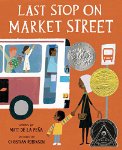
Picture Book Monday with a review of Last Stop on Market Street

Last Stop on Market Street
Today's picture book is very special indeed. It won the 2016 Newbery Award, which is very unusual because typically Newbery winners are novels. The story is so universal and powerful that I had to pause after reading it the first time to take in everything. Then I read it again.

Last Stop on Market Street
Matt De La Pena
Illustrated by Christian Robinson
Picture Book
For ages 5 and up
Penguin, 2015, 978-0-399-25774-2
Every Sunday, after church, CJ and his nana get on a bus and travel across town to Market Street. One Sunday CJ comes out of the church building and it is raining. He does not feel like going across town in the bus today. He resents the rain, he resents the fact that he and Nana cannot travel in a car, he resents the fact that they have to go to the same place after church every Sunday. In short, CJ is not happy with much of anything at the moment.
   One would think that Nana would get annoyed by all of CJ’s complaining questions, but she doesn’t because that is not what Nana is like. Instead, she finds something good to appreciate in everything that CJ finds annoying. What would happen to the trees if they did not have rain to water them? If they had a car they would not get to meet Mr. Dennis the bus driver every Sunday, nor would they see the interesting characters on the bus. If they did not go to the same place every Sunday they would get to spend time with “Bobo or the Sunglass Man.”
   Then a musician starts to play on the bus and CJ begins to experience the joy that Nana understands so well. He begins to understand that sometimes you need to look at what you do have instead of what you don’t.
   This remarkable, award-winning title explores a simple idea through the eyes of a young child. Alongside CJ, on that battered bus, and in the dirty streets, we come to understand that there is beauty everywhere if you know how to look for it.


Friday, March 4, 2016

Poetry Friday with a review of Water Music: Poems for Children

Water Music: Poems for Children

I love water in all its forms. For me, watching waves slap up on a beach is one of the most relaxing things in the world to do, even if it too cold to swim or sunbathe. Just the sound and sight of the moving water is a joy to experience. I think that today's poetry book captures the magic that is water beautifully, and it is a book that children and adults alike will enjoy reading, sharing, and exploring.

Water Music: Poems for Children
Jane Yolen
Photographs by Jason Stemple
Poetry Picture Book
For ages 5 to 7
Wordsong, 2003, 978-1590782514
We often take water for granted, but it is a precious resource. Water covers more of our planet than land does, and like our planet, it makes up most of our bodies as well. Without it, life on earth would not be possible. The amazing thing about water is that it is essential, precious, and also very beautiful. Whether moving in a stream, resting peacefully in a lake, crashing as waves on a seashore, or hanging from the eves of houses as long icicles, it is a joy to look at.
  In this beautifully presented book, Jane Yolen’s poems are paired with her son’s photographs to celebrate water in all its remarkable forms. We begin near a lake where the water “is a magic mirror,” which serves to capture an image of the “earth and sky.” Frozen water appears in the next poem where we see an icicle, which hangs “like frozen time.” Its colors and shape are so unique that “It is itself a poem.”
   When we turn the page we leave behind water in its quiet forms, and come to a place where “the incoming tide / Flings its angry waves upon the shore.” Here the author knows that there is “no hiding place” from the waves, and so retreats to a place where the water will no longer be a threat.
   In the next poem Water Jewels, we encounter water as little droplets sitting on the leaves of weeds. Here water is not in the form of huge waves of enormous power. Instead, water is a delight, beautiful thing, “raindrop diadems” that make our world more lovely.
   A waterfall comes next, with words that tip down the page just like the water does in the accompanying photo. Pulled along by the fast moving water, “Leaves and sticks and twigs” get carried over the waterfall. The waterfall is a “rumbling, tumbling, cataracting fool,” which eventually lands in “its own quiet / pool.”
   This is a wonderful book to share with children as it shows them the many forms that water takes. Sometimes water is peaceful and delicate, while at other times it is strong, powerful and awe-inspiring. Jane Yolen’s poems take many forms, and children and their grownups will wonder at the many remarkable ways that she finds to convey moments, places, and feelings so perfectly.


Monday, February 29, 2016

Picture Book Monday with review of What to do with a box


When I was about nine years old my parents had something shipped to our house that arrived in a very large box. I was thrilled when they said that I could have the box, which a friend and I turned into a house, complete with windows and a door that could open. We drew pictures on the wall and kept all our 'treasures' in that house for as long as it lasted. That box was a fantastic gift, and on this Picture Book Monday we celebrate boxes in all their wonderful charboardy glory.

What to do with a box
Jane Yolen
What To Do With a BoxIllustrated by Chris Sheban
Picture Book
For ages 4 to 7
Creative Editions, 2016, 978-1-5685-46-289-9
When an adult looks at a box he or she sees a container something that can be used to store things in, or transport things from one place to another. In short, a box is a tool. A simple object. However, when a child sees a box he or she sees “a strange device” that can be opened many times and that offers up endless possibilities.
   For one thing, a box is the perfect place to read a book. It could therefore be called a “library.” It is a safe place, a cozy “nook” from which to watch the world go by. These are more practical, down-to-earth uses for a box
   If you are willing to trip down the road into the world of magic and imagination, a box can become a race car, a plane, a ship that can sail “off to Paris / and back.” Why, with a box in hand, you will have “the only / such magic / that you’ll / ever need.”
   Ever since cardboard boxes have been around, children have played in them. Often parents, after going to a great deal of trouble to find the perfect gift for their child, find that their little treasure is happy to play with the box that the gift came in. The gift itself lies on the floor, ignored, while the box is turned into a house, a space ship, or a fort.
   This wonderful book, with its minimal rhyming text and its gorgeous artwork, is a treasure that children will love. Grownups too will enjoy tripping down memory lane as the narrative unfolds, remembering how they too took long journeys and had grand adventures in boxes when they were children.

Friday, February 26, 2016

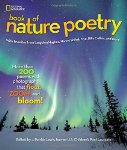
Poetry Friday with a review of Book of Nature Poetry

For me going out into nature is a healing, calming thing to do. When everything else seems to be spinning out of control I go up into the hills above my town and spend time amongst the tall trees, the manzanita shrubs, the little wild flowers, the ravens, and the stellar jays. I feel very lucky that I am able to do this, and am quite content to trade the joys of city living for the wilderness.
   Today's poetry title celebrates nature through poems and beautiful photographs. It is a book for anyone who has looked at a sunset, watched a wild bird. or admired a robust little flower growing up through a crack in the sidewalk.

 Book of Nature PoetryBook of Nature Poetry 
Edited by J. Patrick Lewis
Poetry Picture Book
For ages 6 and up
National Geographic, 2015, 978-1-4263-2094-1
Henry David Thoreau, who famously spent many months in a tiny little building next to a place called Walden Pond, felt that “I have a room all to myself; it is nature.” He knew that the pond and woods just outside his door were places that would give him inspiration and sooth his soul. Amongst the trees and flowers, and in the company of the woodland animals, he found the words that he so needed to share with others.
   Unfortunately, many of us don’t take the time to connect with nature. If we are city dwellers we believe that nature is out of our reach and we don’t even try to seek it out. We are disconnected from the natural world, which is a terrible shame for many reasons.
   More and more we humans are learning that being in nature is healing, and being able to spend time in nature is essential for our emotional, and therefore our general, wellbeing.
   In this incredible book, poems written by poets from around the world are paired with gorgeous pictures of nature in all its glory. Readers are given an armchair journey to far off places, and to places that could be just outside their window. We travel to a beach in California, and a wood in Ireland, we see an African elephant in Mozambique, and a tiger in Bengal. We travel up into the sky, deep under the sea, across open lands, and through forests. We watch the seasons unfold in places all over the world. We also see what Mother Nature can look like when she is riled up. Avalanches, volcanic eruptions, great storms, earthquakes, giant waves, fires and floods are also a part of nature’s story.
   For this collection J. Patrick Lewis, the former U.S. Children’s Poet Laureate, has brought together over 200 poems written in a variety of forms. Some of the poets’ names will be familiar, while others will be new to readers. Some of the poems will be old friends, while others will become new ones.
   This is the kind of book that a young person can grow up with and cherish. It is a book that adults will also enjoy, and even people who are not naturally drawn to poetry will find the combination of photos and words to be captivating.

Monday, February 22, 2016

Picture Book Monday with a review of Bear Can Dance!


Many of us  dream of things that we wish we could do. Some of us are brave enough to pursue these dreams. The problem is that more often than not our expectations and reality don't quite match up, which leads to disappointment. Perhaps our dream just isn't possible after all.

Today's picture book explores how a bear's dream - to learn how to fly - turns out to be not as impossible as it first seems, though it does not quite work out the way he imagined it would.

Bear Can Dance!
Suzanne Bloom
Bear Can Dance! Picture Book
For ages 4 to 6
Boys Mills Press, 2015, 978-1-62979-442-6
One day Bear and Goose fire up the record player and they start dancing. As they dance, Bear tells Goose that he wishes he could fly. Bear would love to “swoop and glide and feel the wind in my fur.” Goose wishes she could help Bear fly but the sad truth of the matter is that bears just aren’t made to fly.
   The Fox shows up and Fox is convinced that she can show Bear how to fly. She gives Bear her cape and goggles and she tells Bear to “flap, flap, flap, and whoosh around.” Bear does as he is told, but instead of feeling “whooshy” Bear feels “woozy,” which is not the same thing at all. The three friends then try sliding down a hill on the snow at full speed but instead of feeling “swoopy,” Bear feels “wobbly.” It would appear that bears really cannot fly after all.
   In this clever, thoughtful, and delightfully sweet picture book, we see how sometimes the dreams we have, the ones that seem impossible, are actually not as impossible as they seem. The problem is that we can’t see them for what they are because they are not exactly as we envisioned them to be. Sometimes we have to open our eyes, use our imagination, and then we see that yes, the dream we have been seeking is right there. It has always been right there.

Friday, February 19, 2016

Poetry Friday with a review of An Ambush of Tigers

An Ambush of Tigers: A Wild Gathering of Collective Nouns
I have reviewed several books that explore collective nouns, and all of them have been interesting. What makes today's poetry book special is that the collective noun words presented to the reader are packaged with wonderful verse that is peppered with clever, and often amusing, word play.

An Ambush of Tigers: A Wild Gathering of Collective Nouns
Betsy R. Rosenthal
Illustrated by Jago
Poetry picture Book
For ages 4 to 6
Millbrook Press, 2015, 978-1-4677-1464-8
A group of humans does not really have a special name, but other animals do have collective nouns, which many of us use regularly. We know that sheep form flocks, and that a group of cows is a herd. The interesting thing is that there are so many other collective nouns for animals out there, many of which are deliciously wonderful and interesting.
   For example, a group of giraffes is called a tower, a gathering of otters is a raft, and a crowd of rats is called a mischief. When you consider that giraffes are very tall, that otters spend much of their life swimming and floating about in water, and that rats are known for being mischievous, these collective nouns seem very appropriate.
  It would be easy to describe these words in a clinical, dictionary sort of way, but in this clever picture book the author uses nonsense poems to introduce us to a delightful collection of collective nouns. For each set of verse she asks a question or two that will make young readers laugh. For example, she wonders if “When a murder of crows, / leaves barely a trace, /is a sleuth of bears hot on the case?” And what about a “parcel of penguins?” Can they be “sent in the mail?” If a “band of gorillas” set up to play a gig, will a “stench of skunks / scare them away?”
   Children will love the clever rhyming questions that appear on the pages of this beautifully illustrated book. At the back of the book they will find a glossary that explores alternate meanings for the collective nouns that appear in the book, meanings that will help them see that some of the collective nouns perfectly match the animal species that they are associated with.


Bookmark and Share